
When someone questions your identity, are they seeking truth—or are they attempting to change the foundation upon which every other claim will be judged?
The first adversarial proceeding recorded in the ministry of Yeshua did not take place before the Sanhedrin.
It did not begin before Pilate.
It did not begin in Gethsemane.
It began in the wilderness.
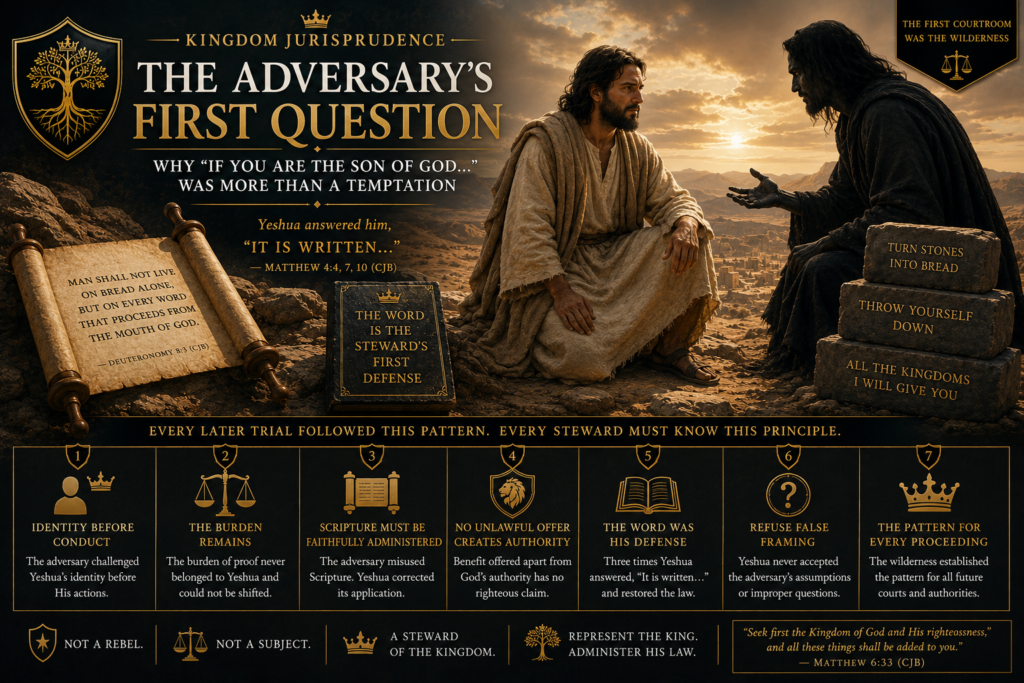
There, the adversary confronted the King with what appeared to be simple questions. Yet these were not sincere inquiries seeking truth. They were carefully framed challenges designed to redefine identity, shift the burden of proof, misuse Scripture, and invite the Son of God to abandon the Father’s revealed standard.
Kingdom Jurisprudence teaches that before a steward can answer a claim, he must first examine the claim itself. The wilderness reveals that the adversary’s greatest weapon was not force—it was the improper framing of the controversy.
The King did not merely resist temptation.
He faithfully administered the Law of God.
Then the Spirit led Yeshua into the wilderness to be tempted by the Adversary.
— Matthew 4:1 (CJB)
Yeshua answered him, “It is written…”
— Matthew 4:4, 7, 10 (CJB)
Every controversy begins somewhere.
Long before false witnesses stood before Caiaphas…
Long before Pilate asked, “What is truth?”…
Long before Roman soldiers mocked the King…
The adversary attempted to establish a different courtroom.
The battlefield was not stones.
It was identity.
It was authority.
It was truth.
It was the proper use of God’s Word.
Everything that followed in the trials of Yeshua can already be seen in this first encounter.
The first words spoken were not commands.
They were questions.
“If you are the Son of God…”
The issue was never whether Yeshua could turn stones into bread.
The issue was whether He would allow the adversary to define the terms by which His identity would be examined.
The faithful steward never permits another party to redefine an identity already established by God.
Identity precedes every claim.
Notice what was required.
“Prove who you are.”
But the Father had already spoken.
“This is My Son…”
The burden did not belong to Yeshua.
The adversary attempted to move it.
Kingdom Jurisprudence teaches that the burden remains with the one making the assertion until that burden has been faithfully discharged.
The King refused to assume a burden that was never His.
In the second temptation the adversary quoted Scripture.
This teaches one of the most important lessons in Kingdom Jurisprudence.
The mere quotation of Scripture does not establish truth.
Scripture must be understood according to its context, purpose, and harmony with the whole counsel of God.
Yeshua did not reject Scripture.
He corrected its misuse.
The kingdoms of the world were offered in exchange for worship.
The offer appeared attractive.
Yet no unlawful agreement becomes righteous simply because the benefit appears desirable.
The faithful steward examines not only what is being offered, but by what authority it is offered.
Three times Yeshua answered:
“It is written…”
He did not appeal to emotion.
He did not argue personalities.
He did not negotiate.
He restored the controversy to its governing law.
The Word of God became the standard by which every claim was measured.
Yeshua never accepted the adversary’s assumptions.
He did not attempt to prove Himself according to another’s standard.
Instead, He restored the discussion to the Father’s revealed truth.
The faithful steward likewise examines every question before accepting its premise.
When false witnesses appeared…
When Caiaphas questioned Him…
When Pilate examined Him…
When Herod mocked Him…
The same principles remained.
Identity.
Truth.
Authority.
Burden.
Scripture.
The wilderness was the first courtroom.
Every later proceeding followed the same pattern.
Before answering any claim, ask:
The wilderness teaches every steward how to prepare before ever standing before magistrates, judges, agencies, or rulers.
Many controversies begin with questions that quietly assume facts not yet established.
Do not rush to answer.
First examine the question.
Identify the assumptions.
Determine the burden.
Measure every claim against the Word of God.
Only then respond.
Faithful administration begins before the first answer is given.
This article intentionally overlaps with:
Understanding the adversary’s first challenge prepares the steward to recognize similar patterns whenever interacting with the nations while remaining faithful to the Kingdom.
The wilderness was not merely a place of temptation; it was the first recorded adversarial examination of the Messiah’s public ministry. Before the King stood before priests, governors, or kings, He demonstrated how a faithful steward answers challenges to identity, authority, and truth. The articles that follow will build upon these same principles until we arrive at The Trials of Yeshua: A Kingdom Jurisprudence Moot Court and Casebook, where these principles are traced through every major proceeding from the wilderness to the resurrection.
“I will not allow another to define the identity God has established, nor will I assume burdens that do not belong to me. I will examine every claim, every question, and every asserted authority in the light of God’s Word. As my King answered the adversary with truth faithfully administered, so I will remain steadfast, measuring every controversy by the Law of the Kingdom and not by the assumptions of this world.”