
Every government operates according to a calendar.
Every organization operates according to a calendar.
Every family operates according to a calendar.
Calendars create rhythm.
Structure.
Order.
Expectations.
Priorities.
The calendar reveals what a people value.
It reveals what they celebrate.
What they remember.
What they anticipate.
What they teach future generations.
Most people live according to calendars established by governments, businesses, schools, or cultural traditions.
Scripture reveals that the Creator also established a calendar.
A Kingdom calendar.
A covenant calendar.
A calendar designed to teach His people.
To shape stewardship.
To preserve remembrance.
To reveal His purposes.
The appointed times are not merely religious observances.
They are part of the Creator’s Kingdom administration.
Understanding them helps the faithful steward align their life with His timing.
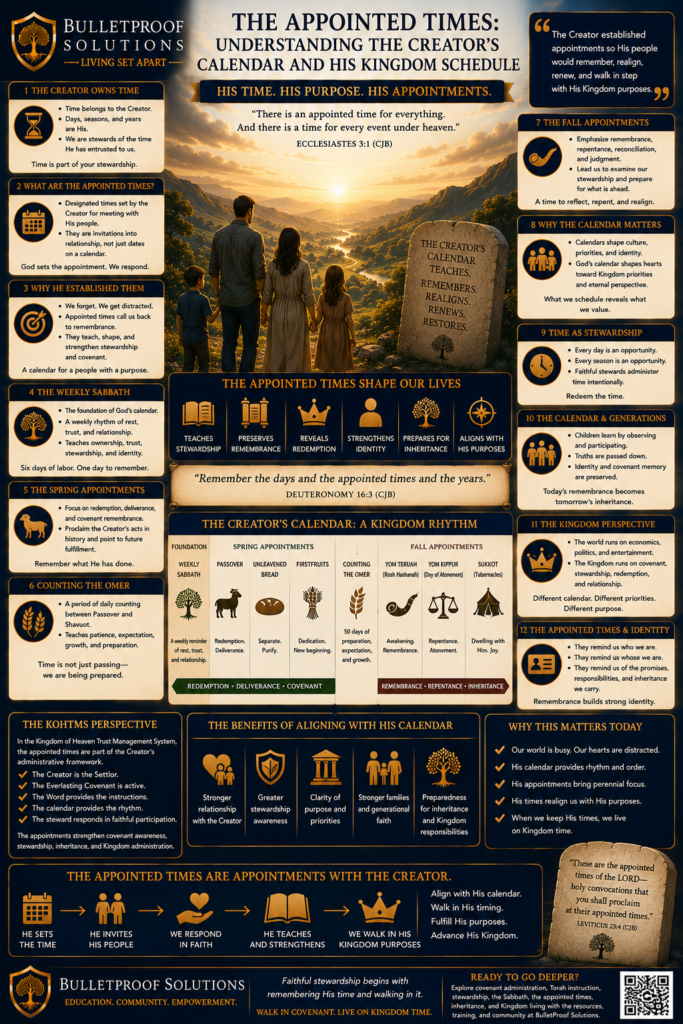
One of the first lessons taught by the appointed times is that time belongs to the Creator.
People often speak of:
“My time.”
“My schedule.”
“My plans.”
Scripture presents a different perspective.
Time belongs to the Creator.
Days belong to the Creator.
Seasons belong to the Creator.
Years belong to the Creator.
The faithful steward therefore recognizes that time itself is part of the inheritance entrusted to them.
The appointed times remind us of this reality.
They return our attention to the One who established time itself.
The appointed times are specific times established by the Creator for meeting with His people.
The Hebrew concept often carries the idea of an appointed meeting.
A scheduled gathering.
A designated time.
The Creator establishes the appointment.
The faithful steward responds.
This perspective changes how the appointed times are viewed.
They are not merely dates on a calendar.
They are invitations into relationship.
The Creator did not establish appointed times because He needed reminders.
We do.
Human beings forget.
We become distracted.
Consumed by daily responsibilities.
Focused upon immediate concerns.
The appointed times interrupt this pattern.
They call the steward back to remembrance.
Back to covenant.
Back to stewardship.
Back to Kingdom priorities.
The calendar becomes a teaching tool.
The weekly Sabbath serves as the foundation of the Creator’s calendar.
Every week the steward pauses.
Remembers.
Rests.
Trusts.
Reconnects.
The Sabbath teaches ownership.
Trust.
Stewardship.
Relationship.
Because it occurs every week, it becomes the recurring rhythm upon which the rest of the calendar is built.
The spring appointments focus heavily upon redemption and deliverance.
The Creator teaches His people through historical events.
Symbolic patterns.
Acts of deliverance.
Covenant remembrance.
The faithful steward learns that redemption is not merely an abstract idea.
It is part of the Creator’s ongoing administration of history.
The spring appointments remind the steward of the Creator’s faithfulness.
One of the most unique periods within the Creator’s calendar involves counting.
Day by day.
Week by week.
The steward learns patience.
Expectation.
Preparation.
Growth.
The counting process itself becomes a stewardship lesson.
It teaches intentionality.
Awareness.
Participation.
The faithful steward learns that time is not merely passing.
It is being administered.
The fall appointments emphasize themes of remembrance.
Reflection.
Repentance.
Reconciliation.
Judgment.
Inheritance.
Kingdom fulfillment.
These appointments encourage the steward to examine their administration.
Review priorities.
Evaluate faithfulness.
Prepare for future responsibilities.
The calendar therefore becomes a recurring system of accountability.
Calendars shape culture.
They shape priorities.
They shape identity.
The Creator’s calendar teaches Kingdom priorities.
Kingdom remembrance.
Kingdom stewardship.
Kingdom identity.
The appointments continually direct attention toward the Creator’s purposes.
This is why the calendar occupies such an important role within covenant administration.
Many people view stewardship primarily in terms of resources.
Scripture includes time among the steward’s responsibilities.
Every day represents an opportunity.
Every week represents an opportunity.
Every season represents an opportunity.
The appointed times help the steward administer time intentionally.
The calendar becomes part of faithful stewardship.
One of the primary functions of the appointed times is education.
Children ask questions.
Families gather.
Stories are shared.
Lessons are remembered.
Future generations inherit understanding.
The calendar preserves covenant memory.
Without remembrance, inheritance weakens.
The Creator’s calendar helps ensure that important truths remain alive from generation to generation.
The world often organizes life around economics.
Politics.
Entertainment.
Commerce.
The Creator’s calendar organizes life around covenant.
Stewardship.
Redemption.
Inheritance.
Relationship.
This distinction changes priorities.
The faithful steward learns to view time through Kingdom purposes rather than merely worldly schedules.
The appointments also reinforce identity.
The steward remembers who they are.
Who the Creator is.
What the covenant means.
What inheritance has been promised.
What responsibilities remain.
Identity grows stronger through remembrance.
This is one reason the appointments remain so important.
Within the Kingdom of Heaven Trust Management System, the appointed times function as part of the Creator’s administrative framework.
The Creator remains the Settlor.
The Everlasting Covenant remains active.
The Word provides the instructions.
The calendar provides the rhythm.
The steward responds through faithful participation.
The appointments strengthen covenant awareness.
Strengthen stewardship.
Strengthen inheritance.
Strengthen Kingdom administration.
Modern life often feels chaotic.
Schedules become crowded.
Attention becomes fragmented.
Priorities become confused.
The Creator’s calendar offers a different rhythm.
A Kingdom rhythm.
A covenant rhythm.
A stewardship rhythm.
The appointments continually redirect attention toward what matters most.
The Creator.
The covenant.
The inheritance.
The Kingdom.
The appointed times are far more than religious observances.
They are part of the Creator’s Kingdom calendar.
A calendar designed to teach.
Remind.
Guide.
Strengthen.
Prepare.
The Creator owns time.
The steward administers time.
The calendar helps align administration with Kingdom purposes.
Every appointment teaches stewardship.
Every appointment strengthens covenant awareness.
Every appointment preserves inheritance.
The faithful steward therefore learns to view the calendar differently.
Not merely as dates to observe.
But as appointments with the Creator.
Because when the steward aligns with the Creator’s calendar, the steward begins to align with the Creator’s purposes.
And where His purposes are remembered, faithful administration becomes possible.
Explore covenant administration, stewardship, Torah instruction, inheritance, Kingdom governance, trusteeship, the Sabbath, and the appointed times through the educational resources, discussions, training programs, and community available through BulletProof Solutions.