
Category: Kingdom Jurisprudence
Reading Time: 18–22 Minutes
Learning Path: Kingdom Jurisprudence Foundations
Featured Course: Kingdom Jurisprudence I – Authority, Covenant & Stewardship (Coming Soon)
Every administration begins with a claim.
Every claim invites examination.
Every examination seeks truth.
Yet before any steward can determine whether a claim ought to be accepted, another question must first be answered.
Who bears the responsibility of establishing the claim?
This question lies at the heart of faithful administration.
Confusion often arises when responsibility is shifted from the one making the assertion to the one responding to it.
Kingdom Jurisprudence seeks order rather than confusion.
The steward therefore asks a simple question before proceeding:
Who has asserted that something ought to be recognized?
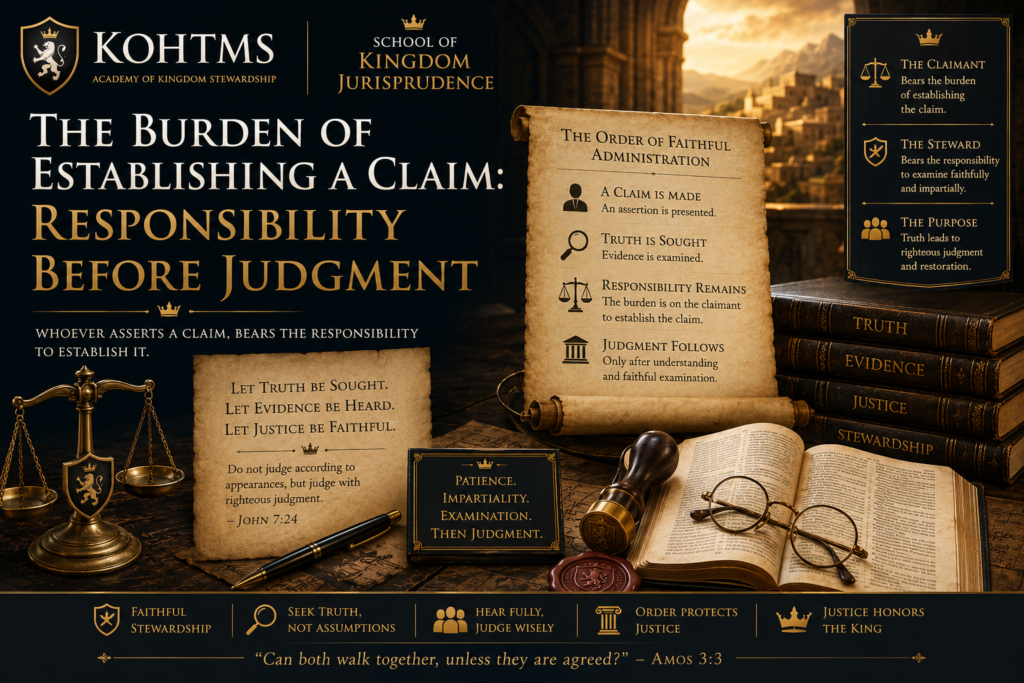
The one making the assertion bears the responsibility of establishing it.
Only then can faithful administration continue.
A claim is more than words.
It is an invitation for another to recognize something as true, rightful, or deserving of action.
Whenever a person asks another steward to acknowledge a claim, responsibility naturally accompanies that request.
The steward is not called to presume.
Neither is he called to reject without consideration.
He is called to examine what has been presented.
Responsibility begins with the one asking another to recognize the claim.
Without this principle, faithful administration quickly becomes disorder.
Assertions multiply.
Questions remain unanswered.
Conclusions become premature.
Justice requires more.
It requires that every claim be capable of examination.
The steward therefore distinguishes between:
An assertion.
Its establishment.
Its acceptance.
These are not the same.
Understanding this distinction preserves both order and justice.
Assumptions are poor substitutes for faithful administration.
A steward does not presume because someone speaks confidently.
Neither does he reject because someone speaks quietly.
Truth is not measured by volume.
Nor is responsibility determined by influence.
The steward patiently asks:
What has been established?
What remains uncertain?
What has yet to be shown?
These questions preserve impartiality.
Many claims begin as allegations.
An allegation is simply an assertion awaiting examination.
Establishment occurs when sufficient truth has been demonstrated for faithful administration to proceed.
Confusing allegations with established facts has produced countless injustices throughout history.
Faithful stewards resist that temptation.
They patiently distinguish one from the other.
The steward does not carry the burden of proving every claim.
Nor does he carry the burden of disproving every assertion.
His responsibility is different.
He administers faithfully.
He listens carefully.
He examines diligently.
He remains impartial.
He renders judgment only after understanding the matter entrusted to him.
This protects both the claimant and the one responding.
Scripture consistently demonstrates restraint before judgment.
Questions precede conclusions.
Examination precedes decisions.
Witnesses precede determinations.
The steward therefore understands that judgment without understanding is neither wisdom nor justice.
Truth must precede judgment.
Otherwise judgment becomes speculation.
Patience is often misunderstood as weakness.
Yet patience protects truth.
It allows claims to be examined.
Evidence to be gathered.
Witnesses to be heard.
Responsibilities to be identified.
The steward who refuses to rush protects everyone involved.
Patience is therefore not delay for its own sake.
It is disciplined stewardship.
The burden of establishing a claim is not a punishment.
It is a stewardship.
The one making the assertion has the opportunity to present the matter clearly.
To explain it faithfully.
To support it honestly.
This encourages responsibility rather than accusation.
The goal is not to create obstacles.
The goal is to create clarity.
A righteous conclusion cannot grow from an unrighteous process.
If responsibility is ignored…
If truth is neglected…
If examination is abandoned…
Even a correct conclusion becomes difficult to trust.
Faithful stewards therefore give as much attention to the process as they do the outcome.
Justice depends upon both.
Faithful administration protects everyone involved.
The claimant deserves to be heard.
The one responding deserves fairness.
The steward deserves sufficient understanding before rendering judgment.
The community deserves confidence that justice has been administered faithfully.
Every person benefits when responsibility remains properly ordered.
Every claim carries responsibility.
Every steward carries responsibility.
Yet those responsibilities are not identical.
The claimant bears the responsibility of establishing the claim.
The steward bears the responsibility of examining it faithfully.
Judgment belongs only after truth has been diligently sought.
This order protects justice.
It protects relationships.
Most importantly, it reflects faithful stewardship.
Before accepting or rejecting any claim entrusted to your administration, ask yourself:
Choose a recent discussion, disagreement, or administrative matter.
Write down:
The goal is not merely to decide who was right or wrong but to cultivate the habits of faithful administration.
Kingdom Jurisprudence I: Authority, Covenant & Stewardship (Coming Soon)
The Foundations of Kingdom Jurisprudence (Coming Soon)
The Role of the Witness: Establishing Truth Through Testimony