
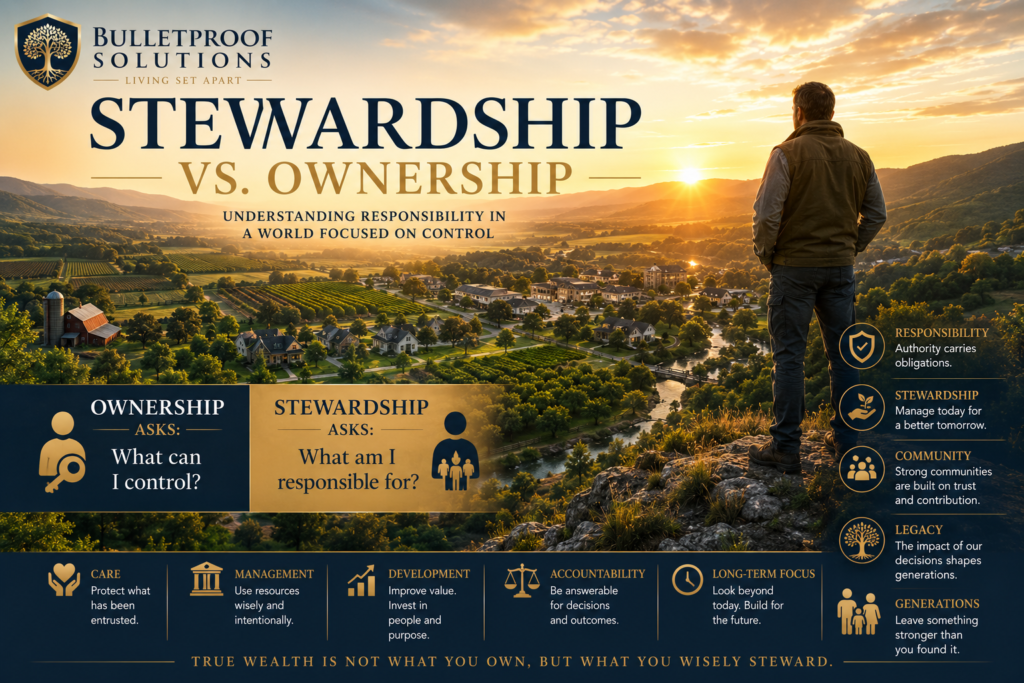
One of the most important distinctions in Kingdom administration is the difference between ownership and stewardship.
Most people spend their lives pursuing ownership.
They seek ownership of property.
Ownership of businesses.
Ownership of wealth.
Ownership of resources.
Ownership of influence.
Ownership of authority.
Yet Scripture presents a perspective that differs dramatically from the assumptions of the world.
The Kingdom begins with a simple truth:
The Creator owns everything.
This truth changes how we view possessions.
Resources.
Authority.
Inheritance.
Governance.
Responsibility.
It changes how we understand ourselves.
Because if the Creator is the Owner, then we are not owners.
We are stewards.
This principle stands at the very heart of the Kingdom of Heaven Trust Management System.
Kingdom administration begins with acknowledging the Creator’s ownership.
King David declared:
“The earth is ADONAI’s, with all that is in it,
the world and those who live there.”
(Psalm 24:1 CJB)
This statement is simple.
Yet its implications are enormous.
If everything belongs to the Creator, then ownership ultimately remains with Him.
Land belongs to Him.
Resources belong to Him.
Time belongs to Him.
Abilities belong to Him.
Inheritance belongs to Him.
Even life itself belongs to Him.
Everything originates with Him.
Everything ultimately returns to Him.
Most systems are built upon the concept of ownership.
Kingdom administration is built upon stewardship.
The difference may appear small.
It changes everything.
Owners ask:
“What belongs to me?”
Stewards ask:
“What has been entrusted to me?”
Owners seek control.
Stewards seek faithful administration.
Owners focus on rights.
Stewards focus on responsibilities.
The steward understands that possession does not create ownership.
Possession creates accountability.
The first stewardship relationship appears in the Garden.
The Creator planted the Garden.
The Creator established its boundaries.
The Creator established its purpose.
Adam was placed within it.
He was instructed to tend it.
Guard it.
Administer it.
Notice what did not happen.
Ownership was never transferred.
Responsibility was transferred.
Administration was transferred.
Stewardship was transferred.
This pattern establishes one of the foundational principles of Kingdom governance.
The Creator owns.
The steward administers.
Human beings naturally gravitate toward ownership.
Ownership appears to provide security.
Independence.
Control.
Status.
Influence.
Yet ownership also creates a dangerous illusion.
The illusion that we are the source.
The illusion that we are autonomous.
The illusion that we answer to no one.
Scripture repeatedly challenges this mindset.
The steward is never the source.
The steward is never the Settlor.
The steward is never the owner.
The steward is accountable to the One who entrusted the stewardship.
Ownership often encourages entitlement.
Stewardship creates accountability.
The steward must answer questions such as:
How was it administered?
Was it protected?
Was it increased?
Was it preserved?
Was it used according to its intended purpose?
These questions lie at the heart of stewardship.
Because stewardship always anticipates an accounting.
The Creator entrusts.
The steward administers.
The steward gives an accounting.
This pattern appears repeatedly throughout Scripture.
The Creator never entrusts resources without purpose.
Time has purpose.
Knowledge has purpose.
Relationships have purpose.
Abilities have purpose.
Resources have purpose.
Authority has purpose.
The faithful steward therefore seeks to understand not only what has been entrusted but why it has been entrusted.
Purpose guides administration.
Purpose guides priorities.
Purpose guides decisions.
Without purpose, stewardship becomes aimless.
One of the greatest misunderstandings of leadership occurs when authority is confused with ownership.
A steward may possess authority.
A trustee may possess authority.
A parent may possess authority.
An elder may possess authority.
None of these positions create ownership.
Authority exists to facilitate stewardship.
Authority exists to fulfill responsibility.
Authority exists to protect what has been entrusted.
The steward remains accountable.
This principle protects against corruption.
The steward understands:
I am not the source.
I am not the owner.
I am not the Settlor.
I am a steward.
This perspective naturally produces humility.
Humility welcomes accountability.
Humility welcomes correction.
Humility recognizes limitations.
Humility strengthens faithful administration.
Pride often emerges when stewardship is mistaken for ownership.
Humility emerges when stewardship is properly understood.
Scripture consistently presents inheritance as something received rather than created.
The inheritance originates with the Creator.
The steward receives it.
Protects it.
Administers it.
Preserves it.
Passes it forward.
This perspective transforms how future generations are viewed.
The steward is not merely managing for themselves.
The steward is preserving for beneficiaries yet to come.
This is one reason stewardship carries such profound responsibility.
Within the Kingdom of Heaven Trust Management System, stewardship serves as the central organizing principle.
The Creator is the Settlor.
The Everlasting Covenant establishes the governing framework.
The Word provides the instructions.
The steward administers according to those instructions.
Nothing exists outside this relationship.
The steward does not seek ownership.
The steward seeks faithful administration.
The objective is not accumulation.
The objective is stewardship.
The objective is not possession.
The objective is faithful execution of the Creator’s Will.
When ownership becomes stewardship, priorities change.
Resources are treated differently.
Relationships are treated differently.
Authority is treated differently.
Inheritance is treated differently.
Time is treated differently.
Life itself is treated differently.
The steward no longer asks:
“How much can I acquire?”
The steward asks:
“How faithfully can I administer what has been entrusted to me?”
This question transforms administration.
The difference between ownership and stewardship is one of the most important distinctions in Kingdom administration.
The world teaches ownership.
The Kingdom teaches stewardship.
The world asks:
“What belongs to me?”
The Kingdom asks:
“What has the Creator entrusted to me?”
This distinction shapes everything.
The Creator owns.
The steward administers.
The Creator entrusts.
The steward accounts.
The Creator establishes purpose.
The steward executes that purpose faithfully.
For this reason, faithful stewardship remains one of the highest callings within the Kingdom.
Because the steward understands a truth that many never discover:
Nothing truly belongs to us.
Everything belongs to the Creator.
And our responsibility is to faithfully administer His trust until the day we give an accounting.
Explore stewardship, trusteeship, covenant administration, inheritance, Kingdom governance, and the Everlasting Covenant through the educational resources, discussions, training programs, and community available through BulletProof Solutions.