
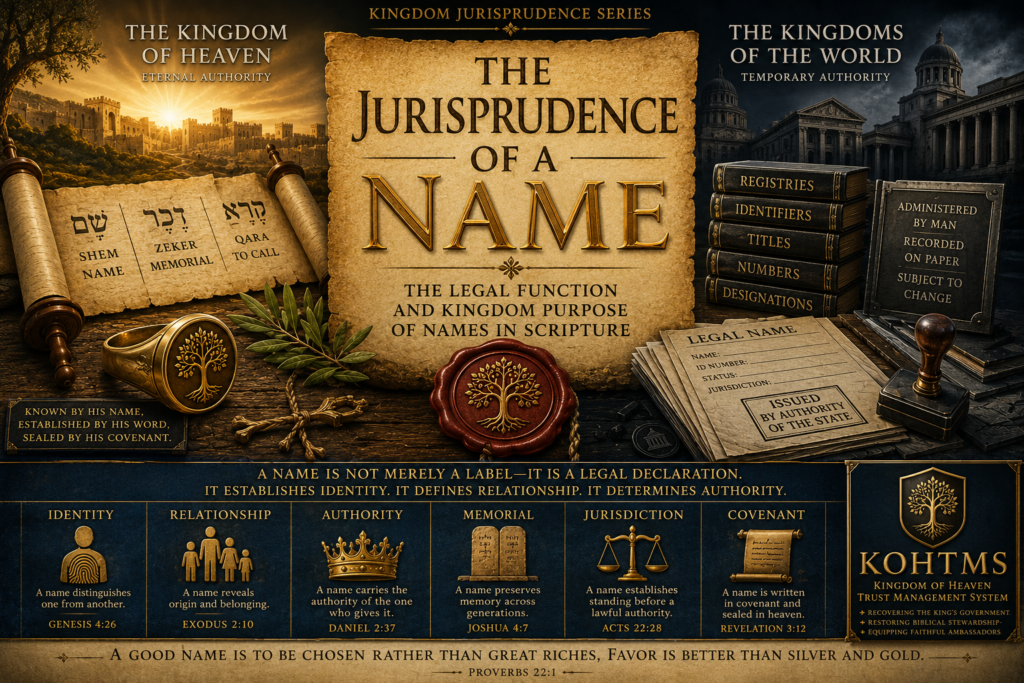
Kingdom Jurisprudence Series
Kingdom of Heaven Trust Management System (KOHTMS)
“A good name is to be chosen rather than great riches, and favor rather than silver and gold.” — Proverbs 22:1 (CJB)
“The Name of ADONAI is a strong tower; a righteous person runs to it and is raised high above danger.” — Proverbs 18:10 (CJB)
In modern society, a name is often viewed as little more than a convenient label.
It identifies a person.
It distinguishes one individual from another.
It appears on identification cards, deeds, contracts, bank accounts, court records, and passports.
Yet Scripture presents something far greater.
Throughout the Bible, a name is never merely a label.
It establishes identity.
It communicates authority.
It defines jurisdiction.
It reveals covenant.
It determines standing.
It identifies inheritance.
It declares lawful representation.
Every legal relationship recorded in Scripture begins with properly identifying the parties.
Without identified parties there can be no covenant.
No inheritance.
No judgment.
No trust.
No commission.
No representation.
Everything begins with identity.
Kingdom Jurisprudence therefore begins with one of the most fundamental questions ever asked:
Who are you?
Not merely what are you called.
But by whose authority has your identity been established?
Every lawful relationship begins by identifying the parties. Every lawful name establishes identity, authority, capacity, jurisdiction, standing, inheritance, and representation.
Throughout Scripture, names perform legal functions.
They are evidence of relationship.
They establish lawful identity.
They reveal covenant.
They communicate jurisdiction.
To understand Scripture properly, we must first understand what a name accomplishes.
Every legal proceeding begins by identifying the parties.
Who is bringing the claim?
Who must answer?
Who possesses rights?
Who bears obligations?
Without identity, law cannot function.
Scripture follows this same order.
“I am ADONAI your God…”
Before giving commandments, God identifies Himself.
Throughout Scripture, God identifies individuals before assigning responsibility.
Adam.
Noah.
Abraham.
Moses.
David.
Yeshua.
Identity always precedes responsibility.
Likewise, before we ask what God requires of us, we must first understand who we are before Him.
To act “in the name” of another is to act under delegated authority.
David confronted Goliath in the Name of ADONAI.
The prophets spoke in His Name.
The apostles healed in His Name.
The disciples were commissioned in His Name.
An ambassador speaks in the name of his king.
A trustee administers in the name of the trust.
A steward acts under the authority of the owner.
The authority never belongs to the representative.
It belongs to the one whose Name he bears.
Authority flows from relationship.
Relationship is identified by name.
The same individual may appear in different lawful capacities.
A man may simultaneously be:
A father.
A husband.
A son.
A trustee.
A steward.
An ambassador.
His identity remains unchanged.
His capacity changes according to the office in which he appears.
Scripture demonstrates this repeatedly.
Yeshua is called:
The Son of God.
The Son of Man.
Messiah.
King.
Judge.
High Priest.
Mediator.
Advocate.
Lamb of God.
Bridegroom.
Each title describes a lawful office.
Each office carries distinct authority and responsibility.
Kingdom Jurisprudence requires us to ask:
In what capacity does this person appear?
Many apparent contradictions disappear once proper capacity is understood.
Names identify the government under which one stands.
When God renamed Jacob as Israel, He established covenant identity.
When Pharaoh renamed Joseph, he asserted Egyptian authority.
When Nebuchadnezzar renamed Daniel and his companions, Babylon attempted to reshape their identity according to its own kingdom.
Throughout Scripture, renaming often marks a transfer of jurisdiction, allegiance, or covenant relationship.
One kingdom claims.
Another kingdom restores.
The question is never simply what someone is called.
The question is:
To whom does this person belong?
Standing answers one question.
Who possesses the lawful right to appear?
Boaz possessed standing to redeem Ruth.
The High Priest possessed standing to enter the Holy of Holies.
David possessed standing to confront Goliath as the representative of Israel’s God.
Yeshua alone possesses standing to redeem mankind because He alone fulfilled every requirement established by the Father.
Standing is never assumed.
It must be established.
Without standing, there is no lawful claim.
Inheritance always follows identity.
The genealogies recorded throughout Scripture are not meaningless lists of names.
They establish lawful inheritance.
Promises belong to identified heirs.
Priesthood belonged to identified families.
Land belonged to identified tribes.
Blessings followed covenant identity.
Without properly identified parties, inheritance cannot lawfully pass.
The Kingdom of Heaven likewise promises an inheritance reserved for those identified as sons and daughters of the King.
Every lawful representative bears another’s authority.
An ambassador represents his king.
A trustee represents the trust.
A prophet represents God.
A disciple represents the Messiah.
Representation is never self-appointed.
It is delegated.
This explains why Scripture repeatedly emphasizes acting in the Name of another.
The Name identifies whose authority the representative bears.
Representation without authority becomes presumption.
Representation with lawful authority becomes faithful stewardship.
When Paul writes that the Father has given Yeshua “the Name above every name,” he is declaring far more than honor.
He is declaring supreme authority.
Every kingdom.
Every government.
Every throne.
Every judge.
Every ruler.
Every authority.
Every jurisdiction.
Every office.
Every name.
Ultimately bows before the authority entrusted to the Messiah by the Father.
The Name above every name is the declaration that all authority belongs to the King whom the Father appointed.
The Scriptures conclude with a remarkable promise.
The one who overcomes will receive a new name known only to the one receiving it.
Throughout Scripture, new names accompany covenant transformation.
Abram.
Sarah.
Israel.
Peter.
The pattern remains consistent.
God names those He transforms.
Our ultimate identity is not determined by the kingdoms of this world.
It is declared by the Father.
The promise of a new name reminds us that our highest identity originates in Heaven—not in earthly administrations.
Every citizen of the Kingdom should regularly ask:
Who defines my identity?
Whose authority do I represent?
In what capacity am I acting?
Under whose jurisdiction do I willingly stand?
Have I established lawful standing before the King?
Am I living according to my inheritance?
Am I faithfully representing the One whose Name I bear?
These are not merely theological questions.
They are questions of Kingdom Jurisprudence.
A name is never merely a word.
It is a declaration.
It identifies the party.
It reveals authority.
It establishes jurisdiction.
It defines standing.
It communicates inheritance.
It authorizes representation.
The kingdoms of this world may assign names for administration.
But the Kingdom of Heaven calls its citizens according to covenant.
The greatest legal question you will ever answer is not:
“What is your name?”
It is:
“Who gave it?”
For the one who possesses lawful authority to name also declares identity.
The one who declares identity establishes relationship.
The one who establishes relationship determines jurisdiction.
And the One who possesses ultimate jurisdiction is the King of kings Himself.
May we never forget that before the world ever called us anything, the Father knew us.
And before eternity is complete, He has promised that those who overcome shall receive a new name spoken by the King Himself.
Kingdom Jurisprudence is a foundational discipline within the Kingdom of Heaven Trust Management System (KOHTMS). It is the systematic study of the laws, jurisdiction, covenant, authority, stewardship, fiduciary responsibility, and administration of the Kingdom of Heaven as revealed throughout the Scriptures.
KOHTMS equips faithful stewards to understand the King’s government, administer His trust faithfully, exercise righteous dominion under His authority, and represent His Kingdom as ambassadors among the nations.
Kingdom of Heaven Trust Management System (KOHTMS)
Recovering the King’s Government.
Restoring Biblical Stewardship.
Equipping Faithful Ambassadors.