
Every person sees the world through a lens.
That lens shapes how they think.
How they make decisions.
How they define success.
How they view authority.
How they use resources.
How they relate to others.
How they understand purpose.
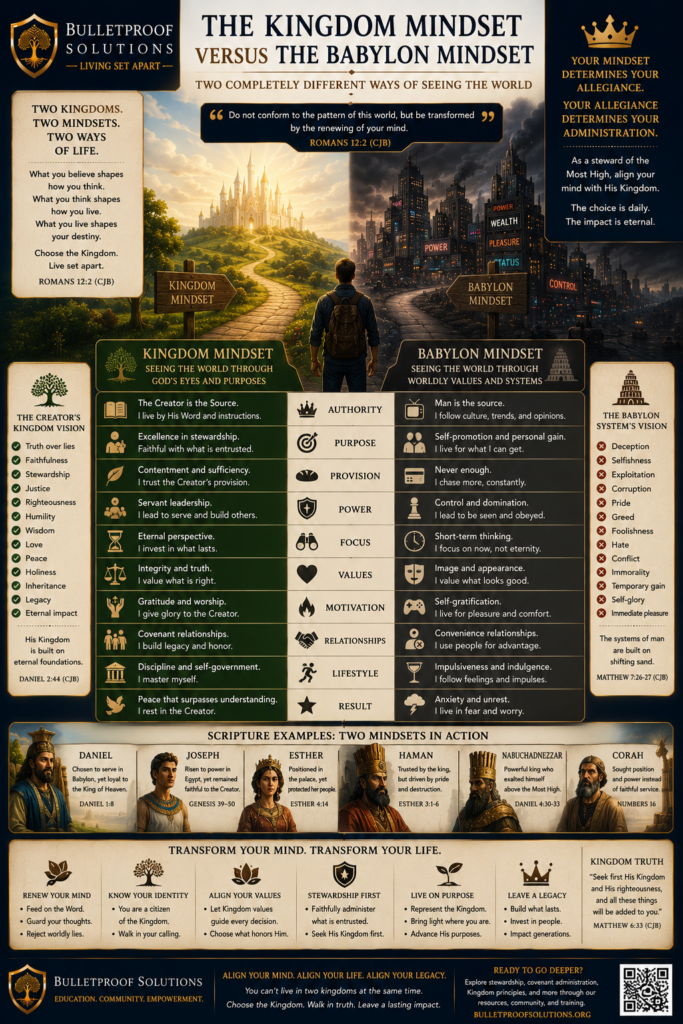
Scripture reveals that humanity ultimately operates from one of two fundamentally different worldviews.
One may be called the Kingdom Mindset.
The other may be called the Babylon Mindset.
These are not merely competing philosophies.
They are competing systems of thought.
Competing systems of administration.
Competing systems of allegiance.
Competing systems of stewardship.
The conflict between these two mindsets appears throughout Scripture and continues to shape the world today.
The faithful steward must understand the difference because every decision ultimately reflects one mindset or the other.
Many people hear the word Babylon and immediately think of an ancient city.
Scripture certainly speaks of the historical Babylon.
Yet Babylon also becomes a recurring symbol.
A symbol of human systems organized independently from the Creator.
A symbol of self-rule.
Self-exaltation.
Centralized power.
Human wisdom elevated above divine wisdom.
Throughout Scripture, Babylon represents mankind’s attempt to build order, security, prosperity, and identity apart from the Creator.
For this reason, Babylon is not merely a location.
It is a mindset.
The Kingdom begins from a completely different foundation.
The Kingdom recognizes the Creator as the source.
The King.
The Owner.
The Settlor.
The ultimate authority.
The Kingdom does not begin with man.
It begins with the Creator.
Everything else flows from that reality.
Purpose.
Identity.
Stewardship.
Governance.
Inheritance.
The Kingdom mindset therefore asks:
What has the Creator established?
What has He instructed?
What advances His purposes?
One of the clearest differences between these mindsets involves authority.
The Babylon mindset treats human institutions as the highest authority.
Public opinion becomes authority.
Experts become authority.
Governments become authority.
Traditions become authority.
Culture becomes authority.
The Kingdom mindset begins elsewhere.
The Creator remains the ultimate authority.
His Word remains the standard.
Human institutions may possess limited delegated authority within their proper spheres, but they never replace the Creator as the highest source.
This distinction changes everything.
The Babylon mindset derives identity from external things.
Status.
Position.
Achievements.
Possessions.
Titles.
Recognition.
The Kingdom mindset derives identity from covenant.
The faithful steward understands:
I am a child of the Creator.
I am a participant in His Kingdom.
I am a steward of His trust.
I am accountable to Him.
Identity becomes stable because it rests upon relationship rather than circumstances.
Babylon often measures success through accumulation.
More wealth.
More influence.
More power.
More recognition.
More control.
The Kingdom measures success differently.
Faithfulness.
Integrity.
Stewardship.
Service.
Trustworthiness.
Obedience.
A person may possess great wealth and still fail as a steward.
Another may possess modest resources and be extraordinarily successful in Kingdom terms.
The measurement differs because the purpose differs.
The Babylon mindset seeks power over others.
Control.
Dominance.
Influence.
Manipulation.
The Kingdom uses authority differently.
Authority exists to serve.
Protect.
Build.
Preserve.
Administer.
Advance the Creator’s purposes.
The faithful steward views authority as responsibility rather than privilege.
This distinction separates Kingdom administration from Babylonian administration.
Babylon teaches ownership.
The Kingdom teaches stewardship.
Babylon asks:
“What belongs to me?”
The Kingdom asks:
“What has been entrusted to me?”
Babylon seeks accumulation.
The Kingdom seeks faithful administration.
Babylon consumes.
The Kingdom preserves.
Babylon measures worth by possessions.
The Kingdom measures faithfulness by stewardship.
This distinction influences every area of life.
The Babylon mindset often focuses on immediate gratification.
Short-term gains.
Temporary pleasures.
Present comfort.
The Kingdom thinks generationally.
The faithful steward considers inheritance.
Legacy.
Future generations.
Kingdom advancement.
The Creator repeatedly teaches His people to think beyond themselves.
Beyond their own lifetime.
Beyond immediate desires.
The Kingdom always looks forward.
Babylon often approaches relationships through utility.
What can this person do for me?
How does this benefit me?
How does this advance my interests?
The Kingdom approaches relationships through covenant.
Service.
Faithfulness.
Honor.
Mutual stewardship.
The faithful steward values people because they bear the Creator’s image.
Not because they provide personal advantage.
Babylon seeks security through external systems.
Money.
Institutions.
Political power.
Control.
The Kingdom places ultimate trust elsewhere.
The faithful steward may use resources wisely, but confidence remains rooted in the Creator.
Security becomes a matter of trust rather than control.
This difference often becomes most visible during times of uncertainty.
One of the earliest examples of the Babylon mindset appears at Babel.
Humanity sought unity apart from the Creator.
Security apart from the Creator.
Identity apart from the Creator.
Purpose apart from the Creator.
The project was not merely architectural.
It was philosophical.
It represented mankind’s attempt to establish order independent of divine authority.
The spirit of Babel continues to appear throughout history.
Different forms.
Different structures.
The same mindset.
The Kingdom follows a different pattern.
The Creator establishes purpose.
The Creator establishes boundaries.
The Creator establishes identity.
The Creator establishes inheritance.
The steward responds through faithful administration.
The Kingdom does not reject order.
It rejects autonomous order.
The Kingdom does not reject administration.
It rejects administration detached from the Creator.
This distinction is critical.
Every action begins with thought.
Every system begins with assumptions.
Every decision reflects a worldview.
The battle between Babylon and the Kingdom therefore begins in the mind.
The faithful steward must continually ask:
Which assumptions am I operating from?
Which values are shaping my decisions?
Which kingdom is influencing my administration?
The answers determine direction.
Within the Kingdom of Heaven Trust Management System, the distinction between these two mindsets is foundational.
The Creator remains the Settlor.
The Everlasting Covenant remains the governing framework.
The Word provides the instructions.
The steward administers according to those instructions.
The Kingdom mindset aligns administration with the Creator’s purposes.
The Babylon mindset seeks administration apart from Him.
Every steward must choose which framework will guide their life.
Modern society is saturated with Babylonian assumptions.
Success through accumulation.
Identity through status.
Security through systems.
Purpose through self-fulfillment.
The Kingdom offers a radically different perspective.
Identity through covenant.
Purpose through stewardship.
Security through trust.
Success through faithfulness.
The faithful steward must learn to recognize the difference.
The Kingdom mindset and the Babylon mindset are not minor variations of the same idea.
They are fundamentally different ways of seeing the world.
One begins with the Creator.
The other begins with man.
One seeks stewardship.
The other seeks ownership.
One seeks service.
The other seeks control.
One seeks covenant.
The other seeks autonomy.
One builds inheritance.
The other consumes inheritance.
Every day the faithful steward faces a choice.
Which kingdom will shape my thinking?
Which kingdom will guide my decisions?
Which kingdom will define my administration?
Because long before kingdoms are built externally, they are first established within the mind.
And the mindset you embrace today will determine the legacy you leave tomorrow.
Explore stewardship, covenant administration, Kingdom governance, trusteeship, inheritance, Torah instruction, and practical pathways for living set apart through the educational resources, discussions, training programs, and community available through BulletProof Solutions.