
One of the greatest mistakes in administration is the belief that one person can successfully do everything.
Many leaders attempt it.
Many families struggle under it.
Many organizations become trapped by it.
Many communities eventually suffer because of it.
The problem is not a lack of effort.
The problem is a misunderstanding of stewardship.
The Creator never intended faithful administration to depend entirely upon a single individual.
Throughout Scripture, responsibilities are distributed.
Stewardship is shared.
Administration is delegated.
Communities function through cooperation rather than concentration.
This principle lies at the heart of Kingdom administration.
It also lies at the heart of the Kingdom of Heaven Trust Management System.
The faithful steward understands that stewardship grows stronger when responsibilities are distributed according to purpose, gifting, and calling.
The Creator possesses unlimited authority.
Unlimited wisdom.
Unlimited capability.
Yet even within Scripture we repeatedly observe the Creator delegating responsibilities.
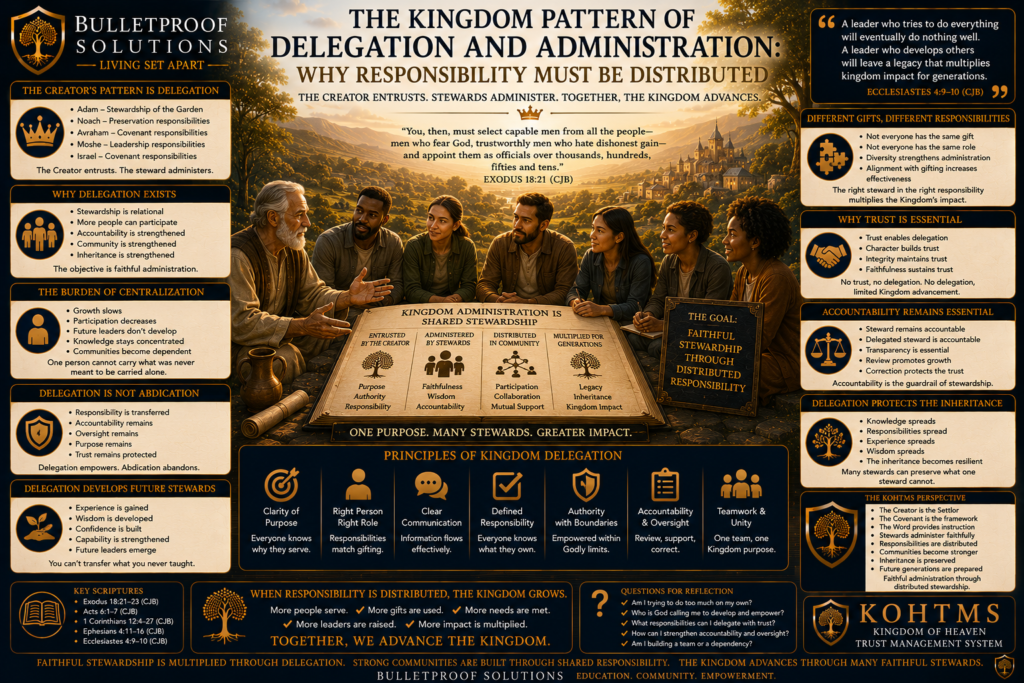
Adam was entrusted with stewardship of the Garden.
Noach was entrusted with preservation responsibilities.
Avraham was entrusted with covenant responsibilities.
Moshe was entrusted with leadership responsibilities.
Israel was entrusted with covenant responsibilities.
The pattern remains consistent.
The Creator entrusts.
The steward administers.
Responsibility is delegated.
Administration follows.
Delegation exists because stewardship is relational.
The Kingdom is not designed around isolated individuals.
It is designed around covenant relationships.
Families share responsibilities.
Communities share responsibilities.
Stewards share responsibilities.
Delegation allows more people to participate in faithful administration.
This participation strengthens stewardship.
Strengthens accountability.
Strengthens community.
Strengthens inheritance.
The objective is not merely efficiency.
The objective is faithful administration.
Many systems become weakened through excessive centralization.
Everything depends upon one person.
One office.
One administrator.
One decision-maker.
At first this may appear effective.
Over time problems emerge.
Growth slows.
Participation decreases.
Future leaders fail to develop.
Knowledge becomes concentrated.
Communities become dependent.
When administration becomes overly centralized, stewardship often weakens.
This is one reason the Creator’s pattern repeatedly distributes responsibility.
One of the clearest examples appears in the administration of Israel during the days of Moshe.
The burden of administration became overwhelming.
Every matter required his direct involvement.
Every dispute required his attention.
Every decision flowed through one individual.
The system became unsustainable.
The solution was delegation.
Faithful individuals were entrusted with responsibilities at multiple levels of administration.
The burden became distributed.
The community became stronger.
Administration became healthier.
The lesson remains relevant today.
Some people confuse delegation with abandonment.
They are not the same thing.
Delegation transfers responsibility for administration.
It does not eliminate accountability.
The steward remains accountable for faithful oversight.
The responsibility remains connected to purpose.
The trust remains protected.
Delegation therefore strengthens administration without abandoning stewardship.
This distinction is critical.
Delegation depends upon trust.
Responsibilities cannot be distributed effectively where trust does not exist.
Faithful stewards therefore invest heavily in developing trustworthy people.
Character matters.
Integrity matters.
Faithfulness matters.
Accountability matters.
The stronger the trust, the stronger the delegation.
The stronger the delegation, the stronger the administration.
This principle explains why trust occupies such an important role within Kingdom communities.
The Creator distributes gifts differently.
Not everyone possesses the same abilities.
Not everyone fulfills the same responsibilities.
Not everyone occupies the same role.
This diversity strengthens administration.
One steward may teach.
Another may build.
Another may organize.
Another may counsel.
Another may protect.
Another may administrate.
When responsibilities align with gifting, stewardship becomes more effective.
The community benefits.
The Kingdom advances.
One of the greatest benefits of delegation is the development of future stewards.
Stewardship cannot be transferred if it is never practiced.
Leadership cannot develop if responsibility is never entrusted.
Future administrators cannot emerge if opportunities are never provided.
Delegation therefore serves future generations.
It creates experience.
Confidence.
Wisdom.
Capability.
The faithful steward understands that developing future stewards is itself a stewardship responsibility.
Delegation never eliminates accountability.
In fact, accountability often becomes more important.
The steward remains accountable.
The delegated administrator remains accountable.
The community remains accountable.
Faithful administration requires transparency.
Communication.
Review.
Correction.
Growth.
Accountability protects both the trust and the people entrusted with its administration.
The Kingdom model differs dramatically from many worldly systems.
The world often centralizes power.
The Kingdom distributes responsibility.
The world frequently concentrates authority.
The Kingdom develops stewards.
The world often seeks control.
The Kingdom seeks participation.
The world frequently creates dependence.
The Kingdom cultivates maturity.
This distinction changes how governance functions.
Because stewardship becomes shared rather than concentrated.
One person can preserve an inheritance for a season.
A community of faithful stewards can preserve an inheritance for generations.
Delegation allows knowledge to spread.
Responsibilities to spread.
Experience to spread.
Wisdom to spread.
The inheritance becomes more resilient.
Future generations become better prepared.
The Kingdom becomes stronger.
This is one reason delegation plays such an important role in covenant administration.
Within the Kingdom of Heaven Trust Management System, stewardship is not intended to remain concentrated within a single individual.
The Creator remains the Settlor.
The Everlasting Covenant remains the governing framework.
The Word provides the instructions.
Stewards administer according to their responsibilities.
Responsibilities are distributed.
Administration becomes shared.
Communities become stronger.
Future generations become prepared.
The objective is faithful execution of the Creator’s expressed Will through distributed stewardship.
Many modern systems suffer from over-centralization.
Responsibility becomes concentrated.
Participation declines.
Dependency increases.
The Creator’s pattern offers a different model.
Develop stewards.
Delegate responsibly.
Share administration.
Build trust.
Strengthen accountability.
Prepare future generations.
The result is healthier stewardship and stronger communities.
The Creator never intended faithful administration to depend entirely upon a single person.
The Kingdom advances through stewardship.
Stewardship advances through delegation.
Delegation develops people.
Strengthens communities.
Protects inheritance.
Prepares future generations.
The faithful steward therefore understands that responsibility must be distributed.
Not because stewardship is unimportant.
But because stewardship is too important to remain concentrated.
The Creator entrusts.
Stewards administer.
Responsibilities are shared.
The Kingdom advances.
And through faithful delegation, the inheritance remains protected from generation to generation.
Explore stewardship, trusteeship, covenant administration, Kingdom governance, inheritance preservation, leadership development, and the Everlasting Covenant through the educational resources, discussions, training programs, and community available through BulletProof Solutions.