
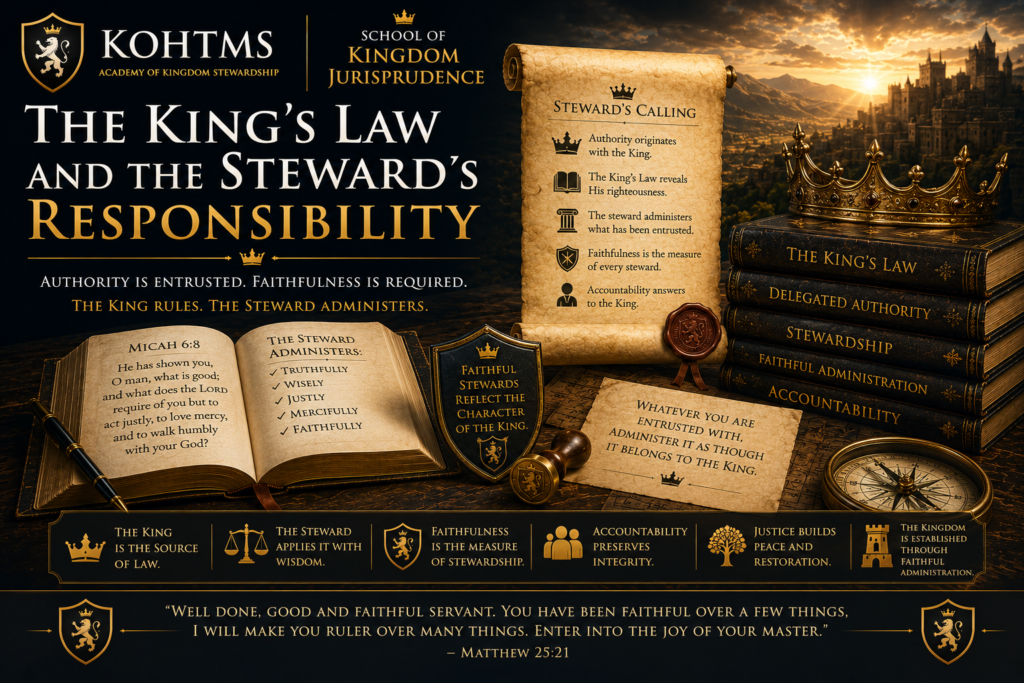
Category: Kingdom Jurisprudence
Reading Time: 20–25 Minutes
Learning Path: Kingdom Jurisprudence Foundations
Featured Course: Kingdom Jurisprudence I – Authority, Covenant & Stewardship (Coming Soon)
Every kingdom reflects the character of its king.
The King’s law reveals His will.
His standards.
His righteousness.
Yet a law, however perfect, does not administer itself.
Throughout Scripture, the King entrusts responsibilities to stewards.
They receive authority.
They receive responsibilities.
They receive things placed into their care.
They are expected to administer faithfully according to the King’s instructions.
This is the calling of every steward.
Kingdom Jurisprudence therefore asks not merely,
“What does the King’s Law say?”
It asks,
“How should the steward faithfully administer what the King has entrusted?”
Law reveals the King’s will.
Stewardship reveals the steward’s faithfulness.
Every previous article has pointed to this truth.
Authority originates with the King.
Delegated authority exists because the King entrusts responsibility.
The steward never possesses independent sovereignty.
His authority always remains derivative.
For this reason the steward continually returns to the King’s instructions rather than relying upon his own wisdom.
Faithfulness begins with submission.
The King’s Law is not merely a list of commands.
It reveals His character.
His righteousness.
His justice.
His mercy.
His holiness.
His faithfulness.
When the steward studies the King’s Law, he learns more than rules.
He learns the heart of the One who gave them.
Faithful administration therefore seeks not only compliance but conformity to the King’s character.
A steward does not own the kingdom.
Neither does he establish its law.
He administers what belongs to another.
This truth echoes throughout the principles already established.
Authority is delegated.
The trust res is entrusted.
Representative capacity is exercised on behalf of another.
Claims are examined faithfully.
Truth is sought diligently.
Witnesses are heard carefully.
Law, equity, and covenant are administered wisely.
Every one of these responsibilities belongs to stewardship.
The King does not ask whether the steward became powerful.
He asks whether he became faithful.
Success measured by the world often emphasizes influence.
The Kingdom emphasizes faithfulness.
The steward is evaluated by how faithfully he administers what has been entrusted.
Not by the size of the responsibility.
But by the integrity with which it is carried.
Delegated authority always possesses boundaries.
The steward may administer.
He may preserve.
He may protect.
He may account.
He may serve.
But he may never presume authority never entrusted to him.
Whenever stewardship exceeds its commission, faithful administration gives way to self-government.
Kingdom Jurisprudence therefore continually reminds the steward:
Remain within the authority that has been entrusted.
Some imagine mercy and justice as opposing principles.
Scripture presents them together.
The King’s Law establishes righteousness.
Equity administers wisdom.
Covenant preserves faithfulness.
Mercy restores where restoration is possible.
Justice protects what is right.
The faithful steward learns when firmness is required and when restoration may accomplish the King’s purpose more fully.
Both serve righteousness.
No steward administers without accountability.
The steward answers to the King.
He also bears responsibility for the matters entrusted to his administration.
This accountability protects both the steward and those under his care.
Power without accountability corrupts stewardship.
Faithful accountability preserves it.
The steward’s objective is not personal victory.
Nor public recognition.
Nor authority for its own sake.
His purpose is faithful administration.
To preserve what has been entrusted.
To administer according to truth.
To judge impartially.
To restore whenever righteousness permits.
To honor the King in every decision.
This is the calling of stewardship.
The steward becomes known not by his own standards but by how faithfully he reflects the King’s character.
When he administers truth…
He reflects the King.
When he administers justice…
He reflects the King.
When he preserves covenant…
He reflects the King.
When he exercises mercy wisely…
He reflects the King.
Faithful stewardship becomes a visible testimony of the King’s government.
The King’s Law reveals righteousness.
The steward applies that righteousness through faithful administration.
Authority belongs to the King.
Responsibility belongs to the steward.
Justice is accomplished when delegated authority is exercised faithfully within the limits established by the King.
Every steward therefore lives under one enduring question:
Have I faithfully administered what the King entrusted to my care?
Consider the responsibilities currently entrusted to your care.
Ask yourself:
Create a “Stewardship Inventory.”
List the areas currently entrusted to your care, such as:
For each area, ask:
This exercise shifts the steward’s focus from possession to faithful administration.
Kingdom Jurisprudence I: Authority, Covenant & Stewardship (Coming Soon)
The Foundations of Kingdom Jurisprudence (Coming Soon)
Faithful Administration: The Highest Duty of Every Kingdom Steward