
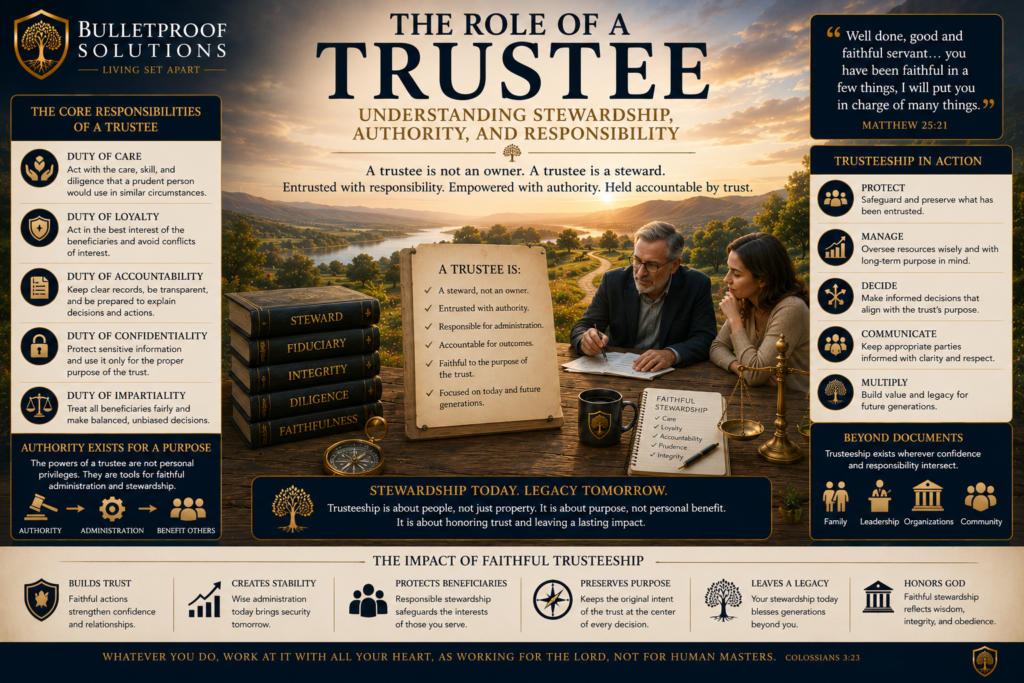
Few positions carry more responsibility than that of a trustee.
The title itself often creates confusion.
Some people assume a trustee is simply the person whose name appears on documents.
Others view trustees as little more than managers of assets.
Still others see the role as purely legal or administrative.
In reality, the role of a trustee is much deeper.
At its core, trusteeship is about stewardship.
A trustee is entrusted with responsibilities that affect the interests of others.
The trustee occupies a position of confidence.
That confidence creates duties.
Those duties create accountability.
Understanding the role of a trustee requires understanding the relationship that gives rise to the position in the first place.
The word “trust” existed long before legal trust instruments.
People trusted family members.
Communities trusted leaders.
Individuals trusted caretakers.
Trust developed whenever one person relied upon another to act faithfully regarding a responsibility.
The trustee relationship emerged from this principle.
One party places confidence in another.
The trusted individual accepts responsibility.
The relationship becomes one of stewardship.
This is why trust administration is fundamentally relational before it is administrative.
Documents may define responsibilities.
Relationships create them.
A trustee is a steward entrusted with responsibilities concerning property, resources, opportunities, or interests that affect others.
The trustee is not merely a holder of authority.
The trustee is a caretaker of responsibility.
This distinction matters.
Many people focus on the powers available to trustees.
The more important question is:
Why were those powers entrusted to the trustee in the first place?
The answer is simple.
To fulfill responsibilities.
Authority exists to support administration.
Administration exists to fulfill obligations.
Obligations exist because confidence was placed in the trustee.
Without confidence, trusteeship would not exist.
One of the most important principles in trusteeship is the connection between authority and responsibility.
Authority without responsibility becomes dangerous.
Responsibility without authority becomes impossible.
Healthy trust relationships require both.
A trustee receives authority for a purpose.
That purpose is administration.
Administration requires decision-making.
Decision-making requires authority.
However, authority never exists independently of responsibility.
Every decision carries consequences.
Every action affects others.
Every exercise of authority should remain connected to the responsibilities that justified it.
When authority becomes separated from responsibility, trust begins to deteriorate.
Perhaps the most misunderstood aspect of trusteeship is the distinction between stewardship and ownership.
The trustee may control resources.
The trustee may administer property.
The trustee may make important decisions.
Yet the trustee is not necessarily acting for personal benefit.
The trustee is acting as a steward.
Stewardship requires a different mindset.
Ownership asks:
“What belongs to me?”
Stewardship asks:
“What has been entrusted to me?”
This perspective changes everything.
The steward focuses on preservation.
The steward focuses on administration.
The steward focuses on responsibility.
The steward recognizes that authority exists to serve a purpose greater than personal advantage.
Trusteeship requires attention.
A responsible trustee does not ignore important matters.
A responsible trustee remains informed.
A responsible trustee monitors circumstances and makes decisions carefully.
This principle is often described as a duty of care.
Care requires effort.
Care requires attention.
Care requires involvement.
The trustee who neglects responsibilities eventually creates risk.
The trustee who exercises diligence creates stability.
This principle applies whether the trustee is managing family affairs, community resources, organizational responsibilities, or formal trust relationships.
Trust depends upon loyalty.
Confidence becomes impossible without it.
When people place trust in another, they expect the trustee to remain faithful to the responsibilities accepted.
Loyalty does not mean perfection.
It means commitment.
It means faithfulness.
It means acting consistently with the responsibilities that have been accepted.
A trustee who places personal interests above responsibilities eventually undermines trust.
A trustee who remains faithful strengthens trust.
This principle has remained central to trusteeship throughout history.
Trusteeship requires accountability.
The trustee should be able to explain actions taken.
Decisions should be understandable.
Records should be maintained.
Administration should remain transparent to the extent appropriate for the circumstances.
Accountability protects everyone involved.
It protects those who place confidence in the trustee.
It protects the trustee as well.
Clarity reduces confusion.
Documentation reduces disputes.
Transparency strengthens trust.
Accountability therefore serves as one of the strongest safeguards within any trust relationship.
Many people assume trusteeship exists only within formal trust instruments.
The principle is much broader.
Parents exercise trustee-like responsibilities toward children.
Leaders exercise trustee-like responsibilities toward communities.
Teachers exercise trustee-like responsibilities toward students.
Administrators exercise trustee-like responsibilities toward organizations.
Whenever confidence and responsibility intersect, trusteeship principles begin to appear.
This broader perspective helps explain why stewardship remains such a universal concept.
Trusteeship is not merely a legal role.
It is a stewardship role.
The most effective trustees think beyond immediate concerns.
They think about preservation.
They think about continuity.
They think about future generations.
Stewards recognize that decisions made today influence opportunities available tomorrow.
Resources preserved today may benefit others decades from now.
Knowledge preserved today may guide future generations.
Relationships strengthened today may create lasting stability.
Legacy thinking encourages trustees to move beyond short-term interests and focus upon long-term stewardship.
Modern society depends upon trust.
Families depend upon trust.
Communities depend upon trust.
Organizations depend upon trust.
Trust requires faithful administration.
Faithful administration requires responsible trustees.
The stronger the trusteeship, the stronger the trust relationship becomes.
This principle remains relevant regardless of the setting.
Whether administering family affairs, managing community resources, operating organizations, or serving within formal trust structures, the same foundational principles apply.
Stewardship.
Responsibility.
Loyalty.
Care.
Accountability.
The role of a trustee is far more significant than many people realize.
A trustee is not merely a title holder.
A trustee is a steward.
A caretaker of responsibilities accepted through relationships of confidence and trust.
Authority exists to support administration.
Administration exists to fulfill responsibilities.
Responsibilities exist because trust was placed in the trustee.
Understanding this relationship transforms how trusteeship is viewed.
It shifts attention away from control and toward stewardship.
Away from power and toward responsibility.
Away from ownership and toward faithful administration.
Ultimately, the measure of a trustee is not how much authority they possess.
The measure of a trustee is how faithfully they steward what has been entrusted to them.
Trust relationships form the foundation of stewardship, administration, governance, and legacy planning.
Explore the educational resources, training programs, community discussions, and weekly calls available through BulletProof Solutions and continue developing a deeper understanding of faithful trusteeship and responsible stewardship.