
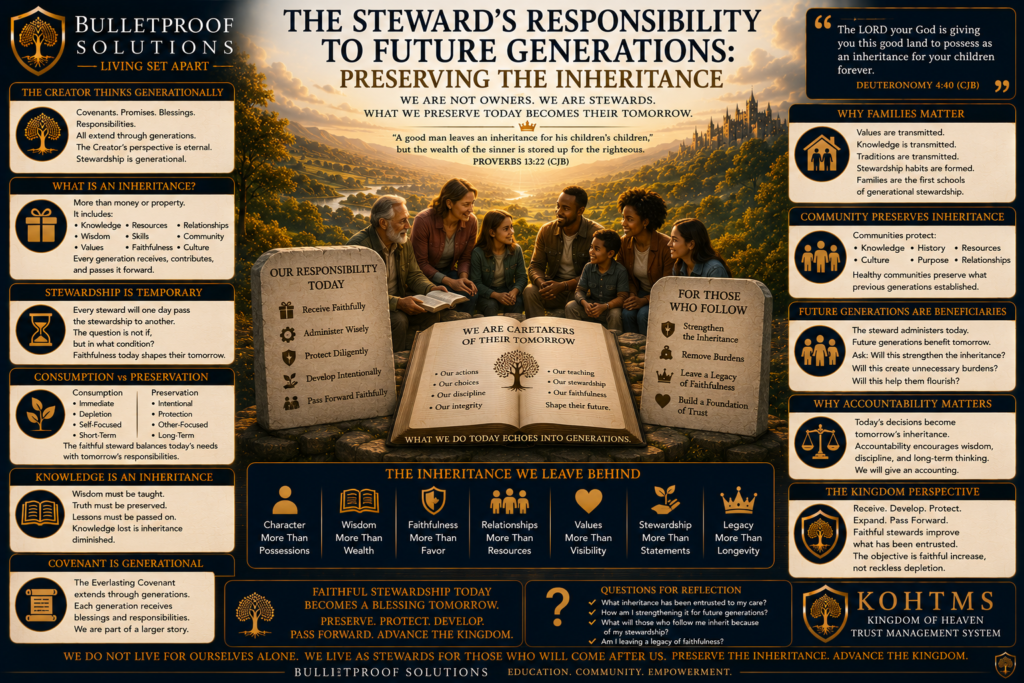
One of the greatest differences between ownership and stewardship is perspective.
Owners often focus upon the present.
Stewards think about the future.
Owners frequently ask:
“What can I gain today?”
Faithful stewards ask:
“What must I preserve for those who come after me?”
This distinction lies at the heart of Kingdom administration.
Throughout Scripture, the Creator consistently emphasizes generational stewardship.
Blessings are passed forward.
Knowledge is passed forward.
Responsibilities are passed forward.
Inheritance is passed forward.
The faithful steward therefore understands that stewardship extends beyond personal benefit.
The steward serves future generations.
This principle stands at the center of the Kingdom of Heaven Trust Management System and the Creator’s pattern for faithful administration.
Throughout Scripture, the Creator repeatedly speaks in terms of generations.
Covenants extend through generations.
Promises extend through generations.
Blessings extend through generations.
Responsibilities extend through generations.
The Creator consistently views stewardship through a generational lens.
What one generation receives is often intended to benefit many generations.
This principle immediately changes how stewardship is understood.
The steward is not merely administering for themselves.
The steward is preserving for others.
Many people immediately think of money or property when they hear the word inheritance.
Inheritance is much broader.
Inheritance includes:
Knowledge.
Wisdom.
Values.
Relationships.
Resources.
Skills.
Land.
Community.
Faithfulness.
Culture.
Stewardship itself.
Every generation receives an inheritance.
Every generation contributes to the inheritance.
Every generation passes inheritance forward.
The question is whether the inheritance is strengthened or diminished during its administration.
One of the most important truths a steward must understand is that stewardship is temporary.
Every steward eventually passes the stewardship to another.
Every leader eventually leaves the office.
Every trustee eventually completes the administration.
Every generation eventually passes the inheritance forward.
This reality creates accountability.
The steward must ask:
What condition will the inheritance be in when I pass it forward?
This question lies at the heart of faithful stewardship.
Consumption focuses upon immediate benefit.
Preservation focuses upon long-term stewardship.
The faithful steward understands that not everything entrusted should be consumed.
Some things must be protected.
Some things must be cultivated.
Some things must be expanded.
Some things must be preserved.
This principle applies to every aspect of stewardship.
Resources.
Relationships.
Knowledge.
Communities.
Inheritance.
The steward balances present needs with future responsibilities.
The Garden provides one of the earliest examples of generational stewardship.
Adam was instructed to tend and guard.
The objective was not merely personal enjoyment.
The objective was faithful administration.
The Garden was entrusted.
It was to be protected.
Maintained.
Cultivated.
The same principle applies throughout Scripture.
The Creator entrusts.
The steward preserves.
The inheritance remains available for future generations.
One of the most overlooked forms of inheritance is knowledge.
Scripture repeatedly emphasizes teaching future generations.
Wisdom must be transmitted.
Lessons must be shared.
Truth must be preserved.
The faithful steward understands that knowledge lost is inheritance diminished.
Knowledge preserved becomes a blessing for those who follow.
This principle explains why teaching occupies such an important place within Kingdom administration.
The Everlasting Covenant itself reveals the Creator’s generational perspective.
The covenant was never intended for a single generation.
The covenant extends through generations.
Each generation receives responsibilities.
Each generation receives blessings.
Each generation receives stewardship opportunities.
The covenant therefore creates continuity.
It connects the past.
The present.
And the future.
The faithful steward recognizes their place within this larger story.
Families play a central role in preserving inheritance.
Values are transmitted through families.
Knowledge is transmitted through families.
Traditions are transmitted through families.
Stewardship habits are transmitted through families.
The family often becomes the first institution of generational administration.
Strong families preserve inheritance.
Weak stewardship frequently weakens inheritance.
This is one reason the Creator places such importance upon family relationships.
Communities also play a vital role in preservation.
No generation preserves everything alone.
Communities help protect:
Knowledge.
Resources.
Relationships.
History.
Culture.
Shared purpose.
Healthy communities become repositories of inheritance.
They preserve what previous generations worked to establish.
They strengthen what has been entrusted.
They pass it forward.
Within the language of stewardship, future generations may be viewed as beneficiaries.
The steward administers today.
Future generations benefit tomorrow.
This perspective changes priorities.
The steward begins asking different questions.
Will this strengthen the inheritance?
Will this weaken the inheritance?
Will this help future generations flourish?
Will this create unnecessary burdens?
These questions reflect mature stewardship.
Generational stewardship creates accountability.
The steward is accountable not only for present administration but also for future consequences.
Short-term thinking often produces long-term problems.
Faithful stewardship considers both.
The steward understands that today’s decisions frequently become tomorrow’s inheritance.
This awareness encourages wisdom.
Patience.
Discipline.
Long-term thinking.
The Kingdom consistently emphasizes multiplication rather than depletion.
The steward receives.
Develops.
Protects.
Expands.
Passes forward.
This pattern appears repeatedly throughout Scripture.
Faithful stewards improve what has been entrusted.
They do not merely consume it.
The objective is faithful increase.
Not reckless depletion.
Within the Kingdom of Heaven Trust Management System, inheritance extends beyond assets.
The Creator remains the Settlor.
The Everlasting Covenant remains the governing framework.
The steward administers according to the Creator’s purposes.
Future generations become beneficiaries of today’s stewardship.
This perspective influences every aspect of administration.
Resources.
Communities.
Families.
Knowledge.
Governance.
Everything becomes part of the inheritance being preserved.
Many modern systems encourage short-term thinking.
Immediate gratification.
Immediate consumption.
Immediate results.
Kingdom administration teaches a different perspective.
Think generationally.
Steward faithfully.
Preserve wisely.
Build intentionally.
Pass forward responsibly.
This perspective strengthens communities.
Strengthens families.
Strengthens inheritance.
Strengthens the Kingdom itself.
Faithful stewards understand a truth that many overlook.
We are not merely recipients.
We are caretakers.
The Creator entrusts inheritance.
The steward administers it.
Future generations receive the results.
This principle transforms stewardship.
The focus shifts from consumption to preservation.
From acquisition to administration.
From self-interest to generational responsibility.
The faithful steward therefore asks:
What am I preserving?
What am I strengthening?
What am I passing forward?
Because inheritance is more than property.
It is knowledge.
Relationships.
Faithfulness.
Community.
Purpose.
And every steward will eventually give an accounting for the inheritance entrusted to their care.
For this reason, faithful stewardship always looks beyond the present generation.
It serves those yet to come.
Explore stewardship, inheritance, covenant administration, trusteeship, Kingdom governance, family stewardship, and the Everlasting Covenant through the educational resources, discussions, training programs, and community available through BulletProof Solutions.