
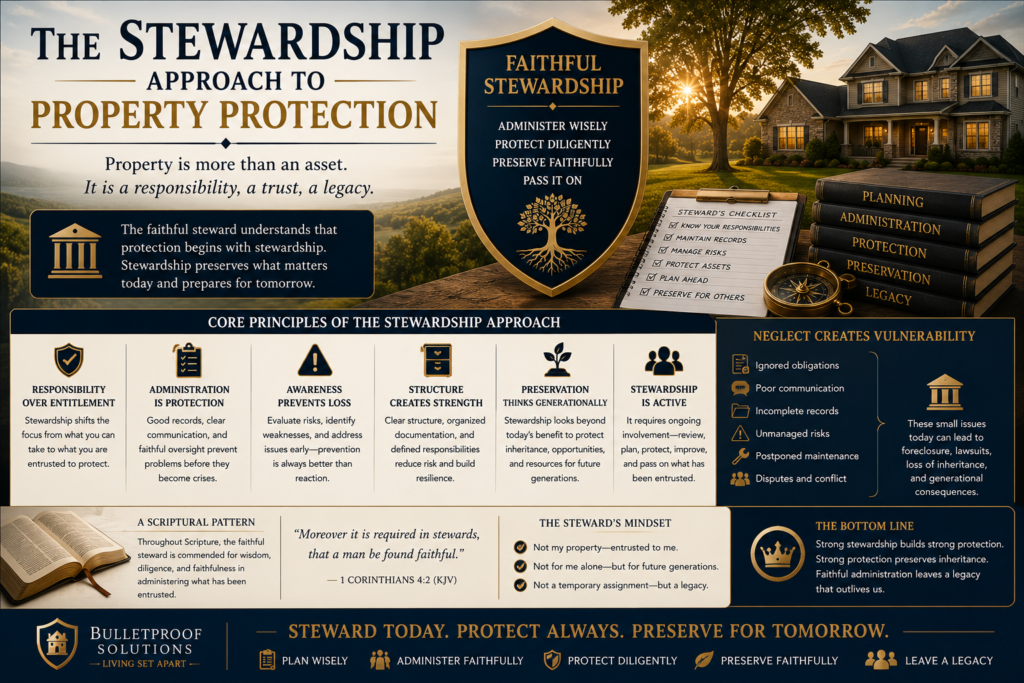
Most people view property through the lens of ownership.
They ask:
What do I own?
What is it worth?
How much equity do I have?
What can I do with it?
These questions are understandable.
Yet they often overlook a more important question.
What responsibility comes with the property?
The faithful steward approaches property differently.
Property is not merely an asset.
It is a responsibility.
An assignment.
A trust.
A stewardship.
This shift in perspective changes how property is administered, protected, preserved, and ultimately passed to future generations.
Ownership often begins with rights.
The owner may possess the right to occupy.
The right to sell.
The right to transfer.
The right to improve.
The right to exclude others.
These rights are important.
Yet rights alone do not guarantee preservation.
Many properties have been lost despite ownership.
Many inheritances have disappeared despite ownership.
Many families have suffered despite ownership.
The existence of rights does not eliminate the need for stewardship.
The steward begins somewhere else.
The steward asks:
What has been entrusted to me?
What responsibilities accompany this property?
How do I preserve it?
How do I administer it properly?
How do I protect it for future generations?
The focus shifts from entitlement to accountability.
The steward recognizes that authority and responsibility must remain connected.
When many people hear the word property, they think only of land or buildings.
Property often includes much more.
Homes.
Businesses.
Equipment.
Intellectual property.
Contractual rights.
Trust interests.
Financial assets.
Inheritance.
Relationships.
Opportunities.
The faithful steward recognizes that all valuable resources require administration.
The same principles apply regardless of the type of property involved.
Property rarely protects itself.
Taxes must be monitored.
Insurance must be maintained.
Records must be preserved.
Agreements must be reviewed.
Liabilities must be managed.
Documentation must be organized.
Many losses occur not because property lacked value but because administration was neglected.
The faithful steward understands that administration is one of the strongest forms of protection.
Property often deteriorates long before it is lost.
Documentation becomes incomplete.
Communication stops.
Obligations are ignored.
Maintenance is postponed.
Risks are overlooked.
The decline may be gradual.
Yet the consequences eventually become visible.
Foreclosure.
Litigation.
Tax problems.
Family disputes.
Loss of inheritance.
The event often appears sudden.
The underlying neglect usually was not.
The faithful steward constantly evaluates risk.
Not out of fear.
But out of responsibility.
Questions are asked.
What obligations exist?
What liabilities exist?
What documentation exists?
What threats exist?
What weaknesses exist?
Awareness allows problems to be addressed before they become crises.
The steward prefers prevention over emergency response.
Many people evaluate property only through the lens of present benefit.
The steward thinks beyond the present.
What will remain for future generations?
What inheritance is being preserved?
What opportunities are being protected?
What knowledge should be transferred?
The stewardship model naturally encourages long-term thinking.
Property becomes more than an asset.
It becomes part of a legacy.
One of the most important lessons in asset protection is that structure matters.
Disorganized administration creates unnecessary risk.
Clear administration reduces risk.
Clear records reduce risk.
Clear responsibilities reduce risk.
Clear authority reduces risk.
The faithful steward values structure because structure strengthens preservation.
Strong structures often survive challenges that destroy weaker ones.
Some people assume stewardship simply means avoiding mistakes.
Stewardship requires much more.
The steward actively protects.
Actively reviews.
Actively plans.
Actively preserves.
Actively improves.
Faithful stewardship requires ongoing participation.
The steward understands that protection is not a one-time event.
It is a continuing responsibility.
Throughout Scripture, the faithful steward is expected to administer wisely.
Resources are entrusted.
Responsibilities are assigned.
Accountings are required.
Inheritance is preserved.
The Creator repeatedly emphasizes faithfulness in administration.
The issue is not merely possession.
The issue is stewardship.
This principle appears consistently from beginning to end.
Many people focus only on the loss itself.
The foreclosure.
The lawsuit.
The tax sale.
The dispute.
The loss becomes the visible event.
The steward asks a different question.
What administrative failures allowed this situation to develop?
This question often reveals the true source of the problem.
The event becomes the symptom.
The administration reveals the cause.
Within the Kingdom of Heaven Trust Management System, stewardship remains central.
The Creator remains the ultimate Owner and Settlor.
Human beings function as stewards and trustees.
Property becomes part of a larger stewardship assignment.
The objective is not merely possession.
The objective is faithful administration.
Protection.
Preservation.
Inheritance.
Continuity.
These goals are achieved through stewardship.
Not through ownership alone.
Modern society often teaches acquisition.
Acquire more.
Own more.
Control more.
The faithful steward asks a different question.
How well am I administering what I already possess?
This question frequently produces better outcomes.
Protection improves.
Preservation improves.
Inheritance improves.
Relationships improve.
Because stewardship strengthens everything it touches.
Property protection begins with stewardship.
Not fear.
Not crisis.
Not litigation.
Stewardship.
The faithful steward understands that property is more than an asset.
It is a responsibility.
A trust.
An assignment.
Property must be administered.
Protected.
Maintained.
Preserved.
The strongest protection strategies are often the simplest.
Good records.
Clear administration.
Proper planning.
Responsible oversight.
Faithful stewardship.
Because when stewardship is strong, risks decrease.
Protection increases.
Inheritance survives.
And future generations receive the benefit of what has been faithfully preserved.
Explore foreclosure defense, asset protection, trust administration, inheritance preservation, stewardship principles, Kingdom governance, and practical educational resources through the courses, discussions, tools, and community available through BulletProof Solutions.