
Mention the word “trust” and most people immediately think about legal documents.
They think about attorneys.
Estate plans.
Asset protection.
Financial arrangements.
Paperwork.
While these things may involve trusts, they are not where trust begins.
Trust begins with relationships.
Long before trust agreements were written.
Long before statutes existed.
Long before courts recognized trust administration.
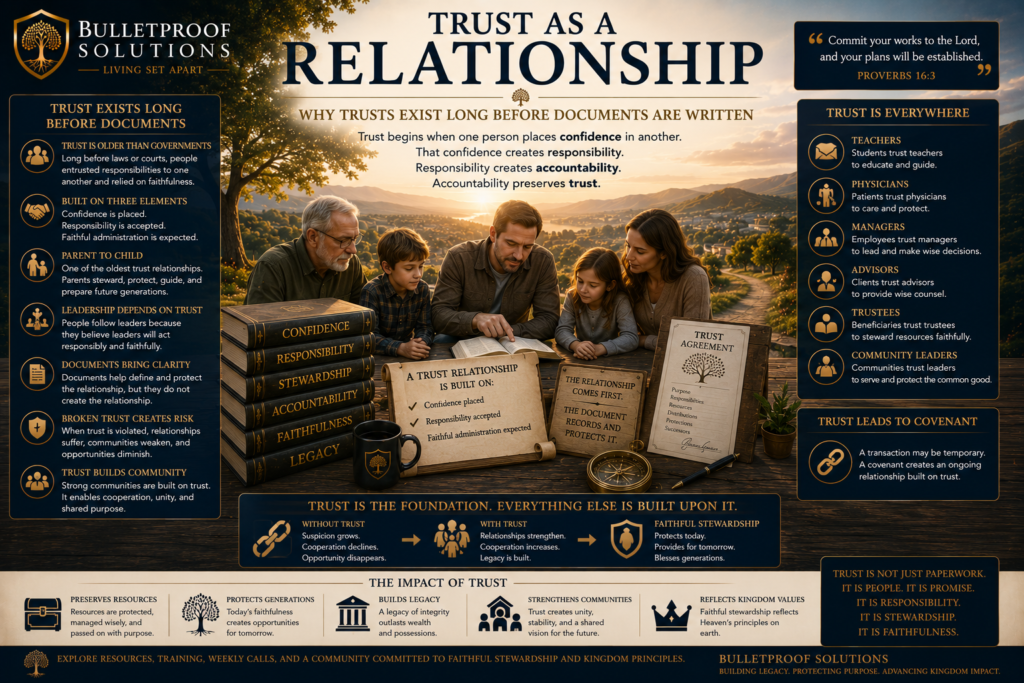
Trust existed whenever one person placed confidence in another.
In fact, every functioning society has depended upon trust relationships.
Families depend upon trust.
Communities depend upon trust.
Businesses depend upon trust.
Leadership depends upon trust.
Without trust, cooperation becomes difficult.
Without cooperation, civilization becomes nearly impossible.
To understand trust properly, we must begin where trust actually starts.
Not with documents.
With people.
Trust is one of the oldest social institutions in human history.
Before formal governments existed, families entrusted responsibilities to one another.
Before courts existed, communities relied upon trusted individuals to manage common concerns.
Before legal systems developed, people still entrusted resources, responsibilities, and opportunities to others.
Trust did not originate in law.
Law eventually recognized and formalized trust relationships that already existed naturally.
This distinction is important.
The document does not create the underlying principle.
The document records and organizes the relationship.
The relationship comes first.
A trust relationship begins whenever three elements exist.
First, confidence.
One person places confidence in another.
Second, responsibility.
The trusted person accepts responsibility.
Third, expectation.
The person placing confidence expects faithful administration of that responsibility.
Whenever these three elements exist, the foundations of trust are present.
The specific circumstances may vary.
The principle remains the same.
Confidence creates responsibility.
Responsibility creates accountability.
Accountability preserves trust.
Perhaps the most obvious example of trust is the relationship between parents and children.
Children depend entirely upon others for care.
They trust adults for food.
Protection.
Guidance.
Education.
Development.
The responsibility accepted by parents resembles trusteeship in many respects.
Parents manage resources.
Make decisions.
Provide direction.
Protect interests.
Prepare future generations.
The relationship is not merely biological.
It is also a relationship of trust and stewardship.
This pattern appears repeatedly throughout society.
Leadership cannot function without trust.
People follow leaders because they believe those leaders will act responsibly.
The moment confidence disappears, leadership becomes difficult.
This principle applies whether the setting is:
Family
Community
Organization
Fellowship
Business
Government
Every effective leader is ultimately operating within a trust relationship.
People place confidence in them.
Responsibilities are accepted.
Accountability becomes necessary.
Trust therefore remains the foundation of leadership itself.
If trust begins with relationships, why do documents exist?
The answer is simple.
Clarity.
As societies became larger and more complex, misunderstandings became more common.
Property became more valuable.
Responsibilities became more extensive.
Multiple generations became involved.
Written agreements helped preserve clarity.
Documents identify:
Responsibilities
Expectations
Resources
Purposes
Procedures
The document serves as evidence of the relationship.
The document does not replace the relationship.
Without the relationship, the document has little meaning.
Many people fail to recognize how frequently trust appears in daily life.
Trust exists whenever:
A teacher educates students.
A physician treats patients.
A manager leads employees.
An advisor provides guidance.
A community leader accepts responsibility.
A trustee administers resources.
A parent raises children.
These relationships vary dramatically.
Yet they share the same foundation.
Confidence.
Responsibility.
Accountability.
Trust therefore is not an unusual concept.
Trust is one of the most common features of human society.
Stewardship and trust are inseparable.
Whenever something valuable is entrusted to another, stewardship becomes necessary.
A steward manages what has been entrusted.
The steward protects.
Preserves.
Improves.
Administers.
The steward understands that responsibility accompanies authority.
This is why trust relationships often produce fiduciary responsibilities.
The greater the confidence placed in someone, the greater the expectation of stewardship.
The principle applies whether the subject is property, knowledge, leadership, relationships, or community resources.
Trust creates opportunities.
Unfortunately, trust also creates vulnerability.
Whenever confidence is placed in another person, the possibility exists that confidence may be violated.
Promises may be broken.
Responsibilities may be neglected.
Resources may be mismanaged.
This reality explains why accountability is so important.
Trust without accountability becomes fragile.
Accountability strengthens trust.
Transparency strengthens accountability.
Stewardship strengthens transparency.
Together these principles help preserve healthy trust relationships.
One reason trust remains so powerful is that trust naturally leads toward covenant.
A transaction may be temporary.
A covenant creates an ongoing relationship.
Trust provides the foundation upon which covenant relationships are built.
Without trust, covenant becomes impossible.
Without covenant, long-term cooperation becomes difficult.
This relationship explains why trust, stewardship, responsibility, and covenant appear together throughout history.
Each strengthens the others.
Strong communities are built upon trust.
People cooperate because they trust one another.
They share resources because they trust one another.
They solve problems together because they trust one another.
The stronger the trust, the stronger the community.
When trust declines, community weakens.
People become isolated.
Suspicion increases.
Cooperation decreases.
The restoration of trust therefore becomes essential to the restoration of healthy communities.
Modern society contains more information than any previous generation.
Yet many people report declining trust.
Trust in institutions.
Trust in leadership.
Trust in media.
Trust in organizations.
Trust in one another.
The solution is not merely better systems.
The solution is stronger relationships.
Trust cannot be manufactured.
It must be earned.
It must be stewarded.
It must be protected.
The future depends upon people who understand how trust relationships function and who are willing to administer them faithfully.
Trust did not begin with lawyers.
Trust did not begin with courts.
Trust did not begin with documents.
Trust began when one person placed confidence in another.
That confidence created responsibility.
Responsibility created accountability.
Accountability preserved trust.
Documents may help organize trust relationships.
They may clarify responsibilities.
They may preserve intentions.
But the relationship always comes first.
Understanding this principle changes how trust is viewed.
Trust becomes more than paperwork.
More than administration.
More than legal structures.
Trust becomes what it has always been.
A relationship built upon confidence, responsibility, stewardship, and faithfulness.
Everything else grows from there.
Trust relationships form the foundation of trusteeship, fiduciary responsibility, stewardship, covenant, and administration.
Explore the educational resources, weekly calls, training programs, and community available through BulletProof Solutions and continue developing a deeper understanding of trust and faithful stewardship.