
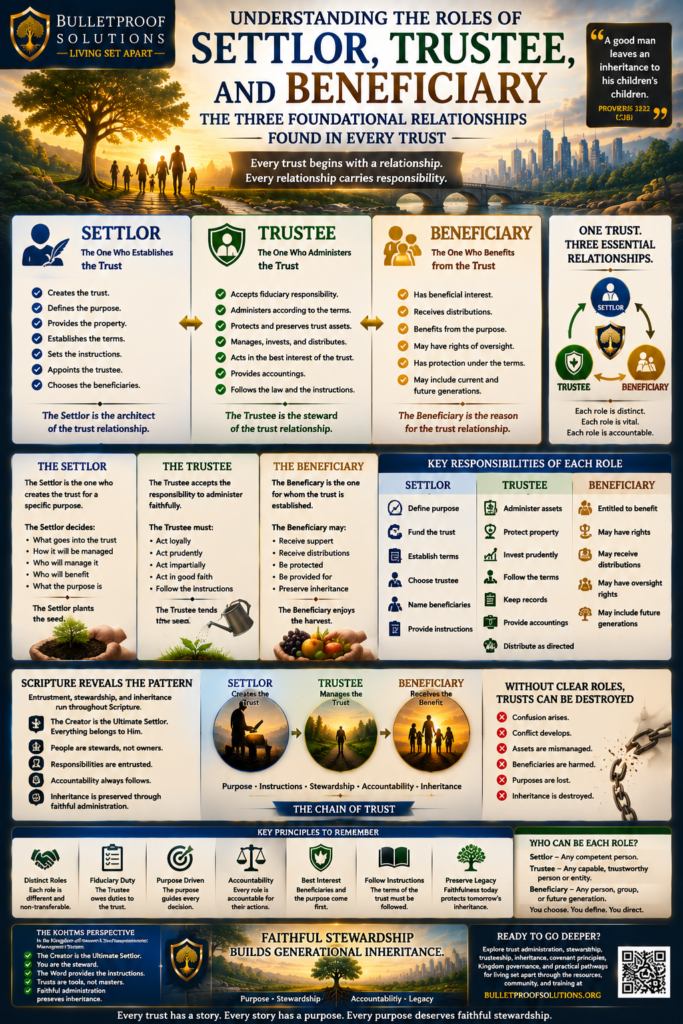
Every trust is built upon relationships.
Not paperwork.
Not statutes.
Not legal terminology.
Relationships.
At the heart of every trust are three foundational roles that work together to accomplish a specific purpose.
The Settlor.
The Trustee.
The Beneficiary.
Understanding these three roles provides the foundation for understanding virtually every trust relationship.
While trusts can become complex, these three roles remain constant.
Each role serves a distinct purpose.
Each carries unique responsibilities.
Each contributes to the overall administration of the trust.
When these roles are properly understood, trust administration becomes much easier to comprehend.
Every successful administration requires clarity.
Without clear roles, confusion develops.
Responsibilities overlap.
Authority becomes uncertain.
Accountability weakens.
The trust relationship exists to accomplish a specific purpose.
The three foundational roles help ensure that purpose is carried out faithfully.
Each role contributes something essential.
The absence of any one role weakens the entire structure.
The Settlor is the person who establishes the trust.
The Settlor creates the relationship.
Defines the purpose.
Provides the instructions.
Determines the objectives.
Identifies the beneficiaries.
The Settlor begins the process.
Without a Settlor there is no trust.
The Settlor answers important questions such as:
Why does this trust exist?
What purpose should it fulfill?
Who should benefit?
How should administration occur?
The Settlor functions as the originator of the trust relationship.
The Settlor contributes more than property.
The Settlor contributes purpose.
Vision.
Direction.
Instructions.
The trust receives its mission from the Settlor.
This mission becomes the standard against which administration is measured.
Faithful trustees continually return to the Settlor’s purpose when making decisions.
Purpose guides administration.
Without purpose, administration becomes directionless.
The Trustee accepts responsibility for administering the trust.
The Trustee becomes the steward of the trust relationship.
This role carries significant responsibility.
The Trustee manages.
Protects.
Preserves.
Administers.
Accounts.
Distributes according to the trust’s purpose.
The Trustee serves as the active administrator.
The Settlor creates the trust.
The Trustee operates the trust.
This distinction is important.
Trustees occupy a position of confidence.
Property is entrusted to them.
Authority is entrusted to them.
Responsibilities are entrusted to them.
Because so much is entrusted, trustees are generally held to a higher standard of conduct.
This standard often includes:
Loyalty.
Faithfulness.
Prudence.
Impartiality.
Accountability.
Honesty.
Good faith administration.
The Trustee’s authority exists for the purpose of serving the trust, not personal interests.
The Trustee serves the purpose.
Not the position.
One of the most common misunderstandings involves ownership.
People often assume the person controlling assets must be the owner.
Trust administration demonstrates otherwise.
The Trustee may administer property.
Protect property.
Manage property.
Distribute property.
Yet administration does not necessarily create ownership.
The Trustee acts as a steward.
A manager.
A fiduciary.
A trustee.
This distinction is one of the most important concepts in trust administration.
The Beneficiary is the person or group intended to benefit from the trust.
The trust exists for a purpose.
The Beneficiary receives the advantages produced by faithful administration of that purpose.
Beneficiaries may be:
Individuals.
Families.
Organizations.
Charitable causes.
Future generations.
Communities.
The Beneficiary represents the reason the trust exists.
Without beneficiaries, there would be little reason to create the trust relationship.
Beneficiaries do not necessarily receive ownership of the trust itself.
Instead, they receive benefits according to the trust’s purpose and instructions.
These benefits may include:
Income.
Support.
Education.
Housing.
Resources.
Opportunities.
Protection.
Inheritance.
The specific benefits depend upon the purpose established by the Settlor.
The Trustee’s role is to ensure these benefits are provided according to that purpose.
The relationship between these roles can be summarized simply:
The Settlor creates the trust.
The Trustee administers the trust.
The Beneficiary receives the benefit of the trust.
Each role depends upon the others.
The Settlor establishes purpose.
The Trustee carries out purpose.
The Beneficiary receives the results of purpose.
This relationship forms the foundation of trust administration.
Purpose connects all three roles.
The Settlor establishes purpose.
The Trustee administers according to purpose.
The Beneficiary benefits according to purpose.
Purpose serves as the guiding principle.
When disputes arise, purpose often provides the solution.
When questions arise, purpose often provides direction.
The trust exists to fulfill a purpose.
Everything else supports that objective.
The concepts of entrustment, stewardship, and inheritance appear throughout Scripture.
The Creator repeatedly entrusts responsibilities.
Individuals administer those responsibilities.
Others benefit from faithful administration.
This recurring pattern resembles the foundational relationships found within trust administration.
The Creator entrusts.
The steward administers.
The inheritance benefits others.
While terminology may differ, the underlying principles remain remarkably consistent.
Within the Kingdom framework, the Creator occupies the ultimate position of Settlor.
Everything originates with Him.
Purpose originates with Him.
Instructions originate with Him.
Inheritance originates with Him.
Human beings function primarily as stewards and trustees.
Responsibilities are entrusted.
Administration follows.
Future generations benefit from faithful stewardship.
This pattern appears repeatedly throughout Scripture.
Within the Kingdom of Heaven Trust Management System, these three roles provide an important educational framework.
The Creator remains the ultimate Settlor.
The Everlasting Covenant establishes the governing relationship.
The Word provides the instructions.
Faithful stewards administer according to those instructions.
The beneficiaries include present and future generations who benefit from faithful covenant administration.
This perspective helps connect trust administration with stewardship and Kingdom governance.
Many problems arise when roles become confused.
When trustees begin acting like owners.
When beneficiaries attempt to become administrators.
When purpose becomes secondary.
Confusion often produces conflict.
Clarity strengthens administration.
Understanding the distinct responsibilities associated with each role helps preserve purpose, accountability, and faithful stewardship.
The clearer the roles, the stronger the administration.
Every trust relationship rests upon three foundational roles.
The Settlor.
The Trustee.
The Beneficiary.
The Settlor creates the trust and establishes the purpose.
The Trustee accepts responsibility for administration.
The Beneficiary receives the intended benefits.
Purpose connects them all.
Responsibility guides them all.
Accountability protects them all.
Understanding these roles removes much of the mystery surrounding trusts.
Trust administration becomes easier to understand because it is ultimately built upon relationships.
Entrustment.
Stewardship.
Purpose.
Inheritance.
Faithful administration.
These principles have existed for generations and continue to form the foundation of trust relationships today.
Because when each role fulfills its proper purpose, the trust accomplishes what it was designed to achieve.
And faithful administration preserves the inheritance for those it was intended to benefit.
Explore trust administration, stewardship, trusteeship, inheritance, covenant principles, Kingdom governance, and practical trust estate education through the educational resources, discussions, training programs, and community available through BulletProof Solutions.