
When most people hear the word trust, they immediately think of paperwork.
Documents.
Attorneys.
Estate planning.
Asset protection.
Legal structures.
Yet trusts existed long before modern trust agreements.
Long before courts.
Long before statutes.
Long before lawyers.
In fact, trust is one of the oldest concepts in human civilization.
Because before there were trust documents, there were trusted people.
Before there were trust agreements, there were entrusted responsibilities.
Before there were trust estates, there were relationships built upon confidence, stewardship, and accountability.
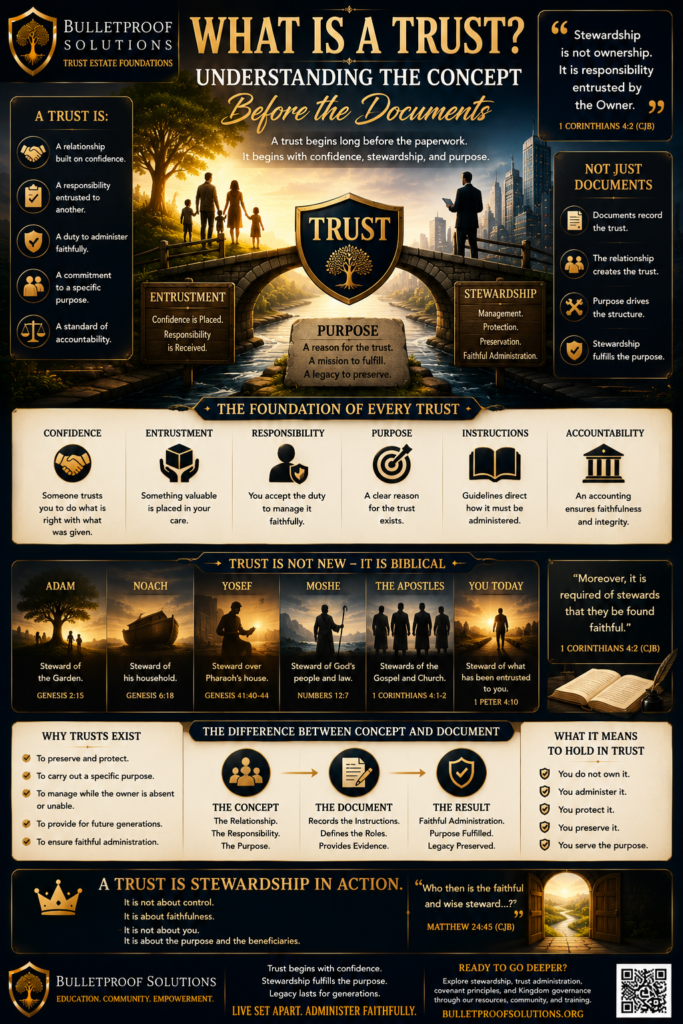
To truly understand trusts, we must first understand the concept before we ever examine the documents.
The documents record the relationship.
They do not create the underlying principle.
The very word trust points us toward its foundation.
Trust requires confidence.
Confidence that another person will act faithfully.
Confidence that responsibilities will be carried out.
Confidence that property will be administered properly.
Confidence that promises will be honored.
Whenever one person entrusts something valuable to another, a trust relationship begins to emerge.
The entrusted person receives responsibility.
The entrusting person extends confidence.
Trust becomes the bridge between them.
This principle is far older than any legal system.
Most people participate in trust relationships every day without realizing it.
Parents entrust children to caregivers.
Families entrust responsibilities to one another.
Business owners entrust responsibilities to employees.
Communities entrust responsibilities to leaders.
Friends entrust confidential information to one another.
The underlying principle remains the same.
Something valuable is entrusted.
Someone becomes responsible.
Accountability follows.
Trust therefore is not unusual.
Trust is foundational to human society itself.
At its core, trust involves stewardship.
A steward administers something that belongs to another.
The steward does not become the owner.
The steward becomes the administrator.
This distinction is critical.
Ownership asks:
“What belongs to me?”
Stewardship asks:
“What has been entrusted to me?”
The trust relationship exists because something valuable requires administration.
The entrusted party accepts responsibility for carrying out that administration faithfully.
Trusts develop whenever responsibility and ownership become separated.
The owner may be absent.
The owner may be unable to administer.
The owner may wish to preserve property for future generations.
The owner may wish to establish instructions that continue beyond their lifetime.
The owner may desire professional administration.
Regardless of the reason, the underlying purpose remains consistent.
The trust exists to ensure faithful administration of what has been entrusted.
Many people assume trusts originated within modern legal systems.
History suggests otherwise.
The concept of entrusting property, responsibilities, and administration to faithful stewards appears throughout ancient civilizations.
More importantly for believers, the concept appears throughout Scripture.
Stewardship.
Entrustment.
Administration.
Accountability.
Inheritance.
Faithful management.
These themes appear repeatedly.
The language may differ.
The principles remain remarkably consistent.
Scripture consistently presents the Creator as entrusting responsibilities to people.
Adam received stewardship responsibilities.
Noach received stewardship responsibilities.
Yosef received stewardship responsibilities.
Moshe received stewardship responsibilities.
The apostles received stewardship responsibilities.
In each case, something was entrusted.
Responsibilities followed.
Accountability followed.
The pattern closely resembles the foundational principles underlying trust relationships.
The Creator entrusts.
The steward administers.
An accounting eventually occurs.
One of the greatest sources of confusion involves ownership.
Many people assume control automatically creates ownership.
Trust principles challenge this assumption.
A trustee may possess authority to administer.
Yet administration does not necessarily create ownership.
The trustee’s role is administration.
Protection.
Preservation.
Management.
Execution of purpose.
The trustee acts on behalf of the trust’s purpose rather than personal benefit.
This distinction separates stewardship from ownership.
Every trust exists for a reason.
Without purpose, administration becomes directionless.
The purpose may involve preservation.
Education.
Family support.
Community benefit.
Future generations.
Specific objectives established by the one creating the trust relationship.
Purpose provides direction.
The trustee’s responsibility becomes carrying out that purpose faithfully.
The purpose therefore becomes one of the most important aspects of the trust relationship.
Once purpose exists, instructions become important.
The entrusted property must be administered according to the established purpose.
Instructions provide guidance.
Boundaries.
Expectations.
Standards.
Without instructions, administration becomes uncertain.
With instructions, administration becomes more consistent.
This principle appears both in traditional trust relationships and in the broader stewardship principles found throughout Scripture.
Trust cannot exist without accountability.
Whenever responsibilities are entrusted, accountability follows.
The faithful steward welcomes accountability.
Accountability protects the purpose.
Protects the beneficiaries.
Protects the entrusted property.
Protects the integrity of the administration.
The absence of accountability often leads to abuse.
The presence of accountability encourages faithful stewardship.
One reason trusts remain so powerful is their ability to extend beyond a single generation.
Trust relationships often preserve resources.
Preserve opportunities.
Preserve inheritance.
Preserve instructions.
Future generations benefit from present stewardship.
This generational perspective appears throughout Scripture as well.
The faithful steward thinks beyond immediate benefit.
The steward considers inheritance.
Legacy.
Future beneficiaries.
Long-term administration.
Many people confuse the trust concept with the trust document.
The document is important.
It records instructions.
Defines relationships.
Provides evidence.
Clarifies administration.
Yet the document is not the trust itself.
The underlying trust relationship exists because someone entrusted responsibilities to another for a particular purpose.
The document simply memorializes that relationship.
Understanding this distinction helps people grasp the true nature of trusts.
Within the Kingdom of Heaven Trust Management System, trust begins with stewardship.
The Creator remains the ultimate Settlor.
The Everlasting Covenant establishes the governing relationship.
The Word provides the instructions.
Human beings function as stewards and trustees of what has been entrusted.
The focus therefore remains upon faithful administration rather than ownership.
Responsibility rather than entitlement.
Stewardship rather than control.
This perspective aligns trust administration with covenant administration.
Modern society often emphasizes ownership.
Control.
Consumption.
Personal benefit.
Trust principles encourage a different perspective.
Stewardship.
Responsibility.
Preservation.
Faithfulness.
Inheritance.
Long-term administration.
These principles strengthen families.
Strengthen communities.
Strengthen future generations.
Most importantly, they help people understand their responsibilities more clearly.
A trust is far more than a document.
A trust begins whenever something valuable is entrusted to another for a specific purpose.
Trust requires confidence.
Stewardship.
Responsibility.
Instructions.
Accountability.
Faithful administration.
The documents may record the relationship.
But the relationship itself comes first.
Understanding this principle transforms how trusts are viewed.
Trust becomes more than paperwork.
More than legal structures.
More than technical administration.
Trust becomes a stewardship relationship.
A responsibility.
An opportunity to faithfully administer what has been entrusted.
And where faithful stewardship exists, trust fulfills its highest purpose: preserving inheritance, advancing purpose, and protecting future generations through responsible administration.
Explore trust administration, stewardship, trusteeship, inheritance, covenant principles, Kingdom governance, and practical trust estate education through the educational resources, discussions, training programs, and community available through BulletProof Solutions.