
When many people hear the word estate, they immediately picture wealth.
Large homes.
Luxury vehicles.
Investment accounts.
Family fortunes.
They assume estates belong only to wealthy people.
This misunderstanding causes many people to overlook one of the most important concepts in trust administration, inheritance, and stewardship.
The truth is much simpler.
Every person has an estate.
The size may differ.
The complexity may differ.
The assets may differ.
But everyone possesses an estate.
Understanding what an estate is—and why it matters—helps people become better stewards, better planners, and better administrators of the resources entrusted to them.
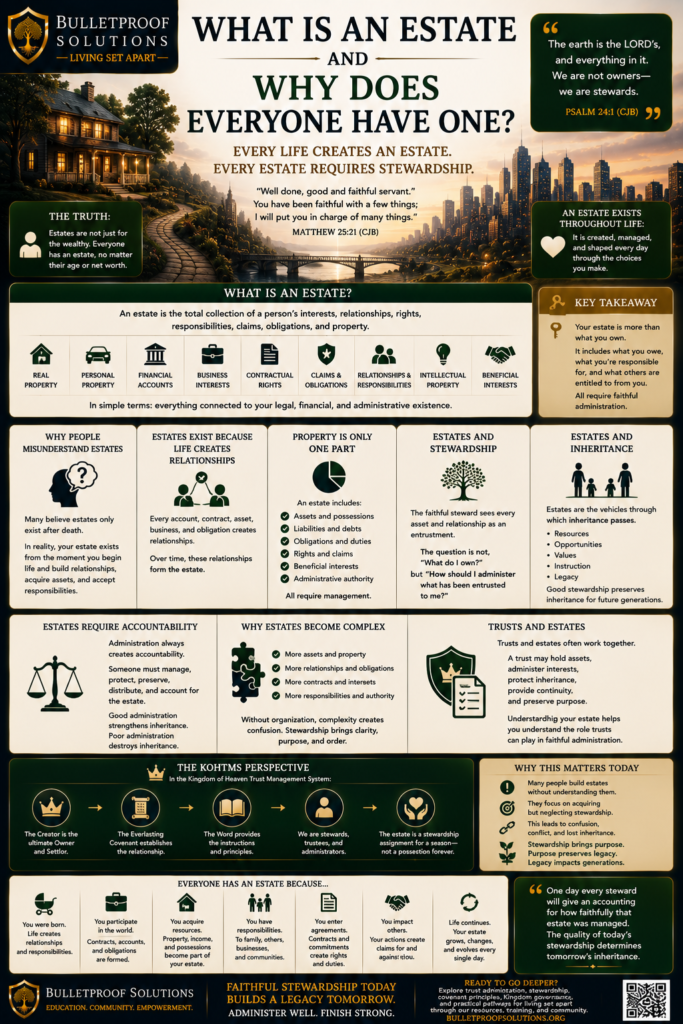
At its most basic level, an estate is the total collection of a person’s interests, relationships, rights, responsibilities, claims, obligations, and property.
An estate includes more than physical things.
It may include:
Real property.
Personal property.
Financial accounts.
Business interests.
Contractual rights.
Claims.
Intellectual property.
Responsibilities.
Debts.
Obligations.
Beneficial interests.
Inheritance rights.
In simple terms, the estate represents everything connected to a person’s legal, financial, and administrative existence.
Whether large or small, everyone has one.
Modern culture often associates estates exclusively with death.
People hear terms such as:
Estate administration.
Estate taxes.
Probate estate.
Estate planning.
As a result, they assume estates come into existence only after death.
In reality, an estate exists throughout life.
Death may trigger certain administrative processes involving the estate.
But the estate itself already existed.
The estate was being accumulated, managed, expanded, reduced, protected, or neglected throughout the person’s lifetime.
Understanding this distinction changes how people view administration.
Every day a person enters relationships.
Some are personal.
Some are financial.
Some are contractual.
Some involve property.
Some involve obligations.
Over time these relationships create an interconnected network of interests.
That network becomes part of the estate.
A bank account creates a relationship.
A home creates a relationship.
A business creates relationships.
Contracts create relationships.
Trusts create relationships.
Beneficial interests create relationships.
The estate becomes the collection of these interconnected interests.
Many people think an estate consists only of assets.
Assets are certainly important.
Yet an estate often includes much more.
An estate may include:
Liabilities.
Obligations.
Responsibilities.
Contractual duties.
Administrative authority.
Beneficial rights.
Claims against others.
Claims held by others.
This broader understanding helps explain why estate administration often involves more than simply distributing property.
The administrator must evaluate the entire estate.
From a stewardship perspective, an estate represents a sphere of administration.
The faithful steward recognizes that every asset carries responsibilities.
Every relationship carries responsibilities.
Every authority carries responsibilities.
The estate therefore becomes more than a collection of possessions.
It becomes a stewardship assignment.
The question shifts from:
What do I own?
To:
How should I administer what has been entrusted to me?
This perspective transforms estate planning into stewardship planning.
Throughout Scripture, people are entrusted with responsibilities.
Land.
Resources.
Families.
Communities.
Livelihoods.
Opportunities.
Inheritance.
These responsibilities create stewardship obligations.
The faithful steward administers these responsibilities according to purpose.
The Creator repeatedly evaluates faithfulness in administration rather than mere possession.
This principle helps explain why stewardship and estate administration are closely connected.
One reason estates matter is because estates often become vehicles through which inheritance passes.
The faithful steward does not merely think about personal benefit.
The steward thinks about future generations.
Knowledge.
Resources.
Opportunities.
Relationships.
Values.
Instruction.
Inheritance includes far more than money.
The estate becomes one means through which inheritance is preserved and transferred.
Every estate requires administration.
Administration creates accountability.
Someone must manage.
Protect.
Preserve.
Distribute.
Account for.
This principle exists whether the estate is large or small.
Good administration strengthens inheritance.
Poor administration often destroys inheritance.
This is why stewardship remains so important.
The estate reflects the quality of its administration.
As life progresses, estates often become more complex.
Additional property is acquired.
Businesses develop.
Relationships expand.
Contracts increase.
Responsibilities multiply.
Beneficial interests accumulate.
Without organization, complexity can create confusion.
Good administration helps maintain clarity.
Purpose.
Direction.
Accountability.
The faithful steward seeks order because order strengthens stewardship.
Many people focus entirely on acquisition.
The next asset.
The next opportunity.
The next investment.
Yet acquisition alone does not guarantee success.
Administration matters.
Protection matters.
Purpose matters.
Stewardship matters.
The faithful steward recognizes that managing resources well is often more important than merely acquiring additional resources.
The estate reflects this reality.
Trusts and estates frequently intersect.
A trust may hold assets.
Administer interests.
Protect inheritance.
Provide continuity of administration.
Preserve purpose.
While trusts and estates are not identical concepts, they often work together.
Understanding the estate helps people better understand the role trusts can play within administration.
Within the Kingdom of Heaven Trust Management System, the estate represents a stewardship assignment.
The Creator remains the ultimate Owner and Settlor.
Human beings function as stewards.
Trustees.
Administrators.
The estate consists of the responsibilities, resources, opportunities, and relationships entrusted during life.
The objective is faithful administration according to purpose.
Not merely accumulation.
Not merely consumption.
Faithful stewardship remains the standard.
Many people spend years building estates without understanding them.
They focus on acquiring while neglecting administration.
They focus on growth while neglecting stewardship.
The result is often confusion, conflict, and lost inheritance.
Understanding the estate helps restore perspective.
The estate becomes more than property.
It becomes a responsibility.
An assignment.
A stewardship opportunity.
Every person has an estate.
Not because they are wealthy.
But because life itself creates relationships, responsibilities, rights, obligations, interests, and property.
The estate is the collection of those interconnected elements.
Some estates are simple.
Some are complex.
All require stewardship.
The faithful steward therefore learns to view the estate differently.
Not merely as a collection of possessions.
But as a stewardship assignment entrusted for a season.
Because one day every administrator will give an accounting for how faithfully that assignment was managed.
And the quality of that administration will determine the inheritance left behind for future generations.
Explore trust administration, stewardship, trusteeship, inheritance, covenant principles, Kingdom governance, and practical trust estate education through the educational resources, discussions, training programs, and community available through BulletProof Solutions.