
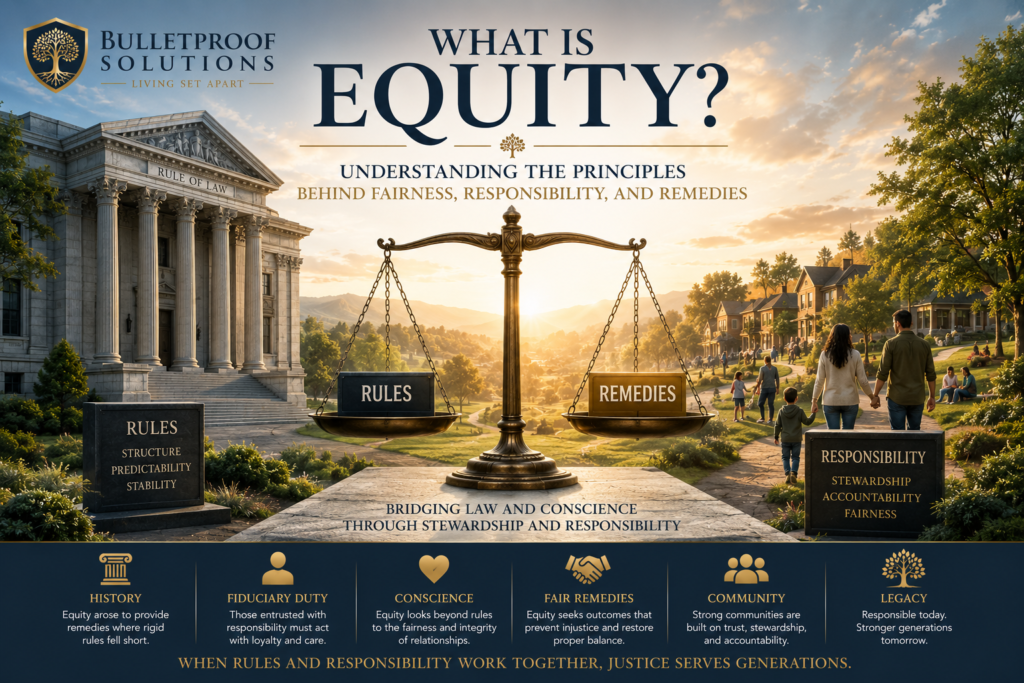
Few words are used more frequently and understood less completely than the word “equity.”
To some people, equity refers to fairness.
To others, it refers to ownership interests.
To still others, it represents a branch of jurisprudence distinct from the common law.
While all of these uses contain elements of truth, equity is best understood as a system of principles designed to address situations where strict application of rules alone may fail to produce an appropriate remedy.
For centuries, equity has influenced governance, administration, trusts, estates, fiduciary relationships, and dispute resolution. Its impact extends far beyond courtrooms and legal textbooks. At its core, equity reflects a simple idea:
Rules matter.
But responsibility matters too.
Understanding equity requires understanding why it developed, how it differs from strict legal systems, and why principles such as stewardship, accountability, and conscience became central to its operation.
Historically, legal systems relied heavily upon fixed rules.
The advantage of fixed rules is predictability.
People can understand what conduct is expected and what consequences may follow.
However, no set of rules can anticipate every possible circumstance.
As societies became more complex, situations arose where rigid application of legal rules produced outcomes that many considered incomplete or inadequate.
A person might technically satisfy the letter of a rule while violating its spirit.
Property might be obtained through conduct that appeared unfair even though no specific legal prohibition had been violated.
Relationships involving confidence and trust often required remedies unavailable through ordinary legal procedures.
These challenges led to the development of equitable principles.
Equity was not intended to replace law.
Rather, it evolved to supplement law where ordinary remedies proved insufficient.
Its purpose was to provide flexibility where strict rigidity produced hardship.
One of the simplest ways to understand the distinction is this:
Law traditionally focuses on rights.
Equity traditionally focuses on responsibilities.
Law often asks:
“What rule applies?”
Equity often asks:
“What remedy is appropriate?”
Law tends to examine conduct according to established standards.
Equity frequently examines relationships, duties, and obligations.
Neither system is inherently superior.
Both serve important purposes.
Predictable rules provide stability.
Flexible remedies provide adaptability.
Together they seek to balance certainty with fairness.
One of the defining characteristics of equity is its emphasis upon conscience.
Historically, equitable principles frequently examined whether conduct was consistent with honesty, good faith, and responsibility.
This did not mean decisions were based solely upon personal feelings.
Rather, equity developed doctrines intended to discourage conduct that violated fundamental principles of fairness.
For example, a person who acted dishonestly might find it difficult to obtain equitable relief.
Similarly, a person seeking fairness from others was generally expected to demonstrate fairness in their own conduct.
This emphasis upon mutual responsibility became one of equity’s defining characteristics.
Many of the situations historically associated with equity involved fiduciary relationships.
A fiduciary relationship exists whenever one person places confidence in another regarding a responsibility.
Examples include:
Trustees and beneficiaries.
Guardians and wards.
Partners in business ventures.
Executors and estates.
Corporate officers and organizations.
These relationships involve more than mere transactions.
They involve confidence.
Because confidence creates vulnerability, equitable principles often developed to ensure accountability.
The central question frequently became:
Was the responsibility exercised faithfully?
This focus on stewardship remains one of equity’s most enduring characteristics.
The concept of stewardship appears repeatedly throughout equitable history.
A steward is entrusted with responsibility.
They are expected to manage resources, opportunities, or relationships in a manner that serves legitimate interests rather than personal advantage alone.
This principle appears in numerous settings.
A trustee manages trust property.
A guardian manages affairs for another person.
An administrator manages an estate.
A corporate director manages organizational resources.
Although the specific duties differ, the underlying principle remains consistent.
Responsibility accompanies authority.
The greater the responsibility, the greater the expectation of accountability.
Equity developed many of its doctrines specifically to address situations where this balance broke down.
Over time, numerous equitable doctrines emerged.
While entire books have been written about these principles, several themes appear repeatedly.
The principle often summarized as “clean hands” reflects the idea that individuals seeking equitable relief should themselves act fairly.
Estoppel generally prevents individuals from taking positions inconsistent with previous representations when others have reasonably relied upon those representations.
This principle addresses situations where one person receives benefits under circumstances that may make retention of those benefits inappropriate.
A constructive trust may be used to address situations where property has been obtained or retained under circumstances requiring accountability.
Rather than awarding monetary compensation, specific performance seeks fulfillment of an obligation when money alone may be inadequate.
Although these doctrines vary significantly, they share a common objective:
Encouraging responsibility and preventing abuse.
Many people assume equity is relevant only to legal disputes.
In reality, equitable principles influence everyday life.
Consider a family.
Parents exercise responsibilities toward children.
Trust develops through faithful stewardship.
Accountability maintains confidence.
Now consider a business.
Managers are entrusted with resources.
Employees depend upon leadership.
Customers rely upon representations.
Trust and responsibility remain central.
The same principles appear in organizations, communities, ministries, partnerships, and friendships.
Equity therefore reflects more than a legal framework.
It reflects a way of understanding relationships.
At its core, it asks whether responsibilities have been exercised faithfully.
Modern society depends upon trust.
Families depend upon trust.
Communities depend upon trust.
Organizations depend upon trust.
Trust requires accountability.
Accountability requires responsibility.
Responsibility requires stewardship.
These ideas remain as relevant today as they were centuries ago.
While laws establish boundaries, equitable principles remind us that relationships involve obligations as well as rights.
They encourage individuals to look beyond technical compliance and consider whether conduct aligns with broader responsibilities.
In this sense, equity serves as a bridge between rules and relationships.
Equity developed because human relationships are more complex than rules alone can fully address.
Its purpose has never been to eliminate structure or predictability.
Rather, it seeks to ensure that responsibility accompanies authority, that stewardship accompanies control, and that accountability accompanies trust.
At its foundation, equity recognizes a simple truth:
People do not merely interact through rules.
They interact through relationships.
Where relationships involve confidence, responsibility, and stewardship, equitable principles continue to provide valuable guidance.
Understanding equity therefore is not simply about understanding a branch of jurisprudence.
It is about understanding how trust, responsibility, and accountability work together to create stronger families, healthier organizations, and more resilient communities.
Equity is only one part of a much larger conversation about stewardship, responsibility, trust relationships, administration, and governance.
If these concepts interest you, explore the educational resources, discussions, and training available through the Exploring Foundations Membership at BulletProof Solutions and continue building a deeper understanding of the principles that shape successful administration and responsible stewardship.