
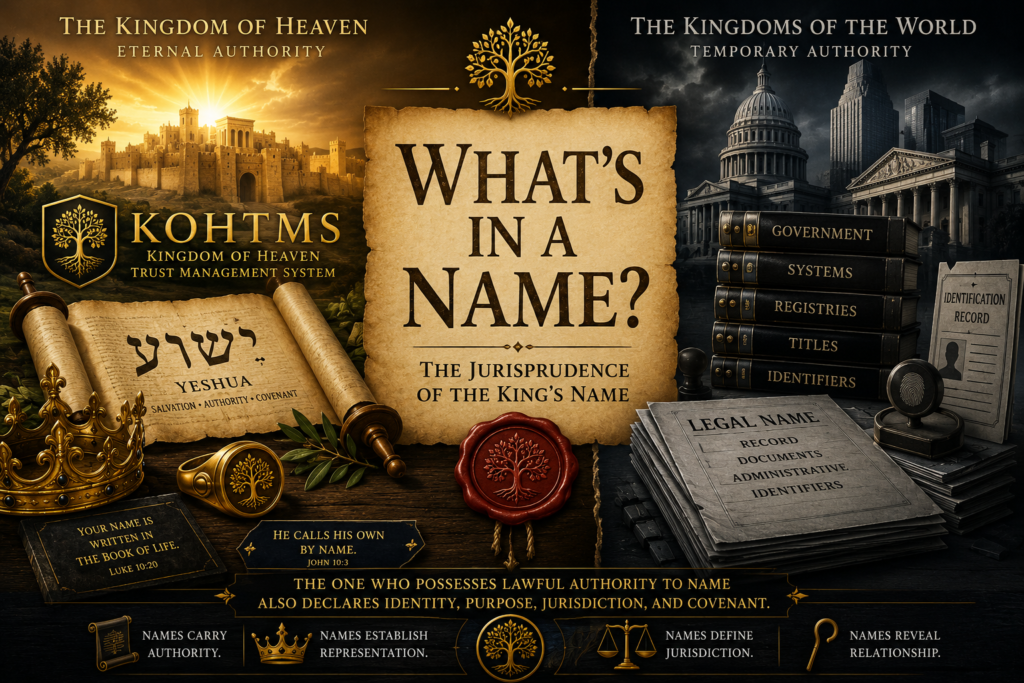
Kingdom Jurisprudence Series
“Therefore God also highly exalted Him and gave Him the Name that is above every name, so that in honor of the Name given Yeshua, every knee will bow—in heaven, on earth and under the earth—and every tongue will acknowledge that Yeshua the Messiah is ADONAI—to the glory of God the Father.”
— Philippians 2:9–11 (CJB)
If every record of your existence were erased today—your deeds, contracts, trusts, driver’s license, passport, bank accounts, court records, and public registrations—how would you establish your identity?
Every court begins with the same fundamental question:
Who is the party before the court?
Before a court can determine rights, it must determine identity.
Before authority can be exercised, lawful standing must be established.
Before an ambassador may negotiate, he must demonstrate the authority of the sovereign who sent him.
Identity precedes jurisdiction.
Standing precedes relief.
Authority precedes action.
Scripture teaches precisely the same principle.
From Genesis to Revelation, names are never treated as mere labels. They identify covenant, authority, inheritance, jurisdiction, purpose, reputation, and lawful representation.
Modern culture often reduces names to sounds.
The Kingdom never does.
This raises one of the most overlooked questions in all of Scripture.
Who possessed the lawful authority to name the Messiah?
The answer to that question reveals far more than pronunciation.
It reveals jurisdiction.
The one who possesses lawful authority to name also declares identity, purpose, jurisdiction, and covenant.
Throughout Scripture, the authority to name belongs to the one possessing lawful dominion.
Names establish identity.
Names reveal purpose.
Names identify lawful relationship.
Names testify to ownership.
Names declare covenant.
This principle appears repeatedly throughout the Scriptures.
The very first One recorded naming is God Himself.
He called the light Day.
He called the darkness Night.
He called the heavens Heaven.
He called the earth Earth.
He called the seas Seas.
Creation and naming proceed together.
The Creator possesses the authority to declare identity.
Later, Adam is instructed to name the living creatures.
This was not an exercise in creativity.
It was delegated dominion.
God entrusted Adam to exercise authority within the jurisdiction assigned to him.
Even before sin entered creation, naming reflected lawful administration.
Whenever God establishes covenant, names frequently change.
Abram becomes Abraham.
Sarai becomes Sarah.
Jacob becomes Israel.
Simon becomes Peter.
Each new name reflects more than a personal change.
It signifies a new identity, a new commission, and a new relationship with God.
The new name follows the covenant.
God never changes a name casually.
He changes it because identity itself has changed.
Scripture also reveals another pattern.
Earthly kingdoms rename.
Pharaoh gives Joseph an Egyptian name.
Nebuchadnezzar renames Daniel, Hananiah, Mishael, and Azariah.
Why?
Because empires seek more than obedience.
They seek identity.
A conquered people are easier to assimilate when they gradually forget who they are.
Renaming becomes an expression of earthly authority.
It proclaims:
“You now belong to this kingdom.”
Babylon renamed captives.
God restored covenant identity.
The contrast is unmistakable.
When the Messiah entered history, His Name was not selected by family custom.
It was declared by Heaven.
The angel instructed Joseph:
“You are to name Him Yeshua, because He will save His people from their sins.”
The Father had already determined both His identity and His mission.
The Name itself testified:
YHWH Saves.
The gospel was embedded within the Name before the Messiah ever preached His first sermon.
His authority came from the Father.
His commission came from the Father.
His Name came from the Father.
Nothing about Him originated from men.
Modern readers often misunderstand the phrase:
“In My Name.”
In Scripture, this is language of lawful representation.
David confronted Goliath in the Name of ADONAI.
The prophets spoke in His Name.
The apostles healed in His Name.
Believers prayed in His Name.
Disciples were sent in His Name.
To act in another’s name is to act under the authority of the one who sent you.
An ambassador does not represent himself.
A trustee administers under the authority of the trust.
An agent acts under delegated authority.
The authority never belongs to the representative.
It belongs to the one whose Name he bears.
This is why Scripture places such extraordinary emphasis upon the Name.
The Name identifies whose authority is being exercised.
This discussion is not ultimately about phonetics.
Languages change.
History records that the Hebrew Name given by Heaven was rendered into Greek, then into Latin, and eventually into English as the message spread among the nations.
Yet Kingdom Jurisprudence asks a deeper question.
If the Father intentionally gave His Son a Name declaring His identity and mission, should disciples desire to understand that Name as it was given?
Every time the Name Yeshua is spoken, it declares:
YHWH Saves.
The Father’s testimony remains embedded within the Name itself.
Recovering that understanding is not merely recovering Hebrew.
It is recovering covenant.
Every kingdom identifies those under its administration.
Earthly governments maintain registries.
Kingdoms maintain citizenship.
Courts identify parties.
Institutions assign numbers.
The Kingdom of Heaven also identifies its citizens.
But not according to earthly administration.
According to covenant.
Before your birth was recorded by any earthly authority…
The Father knew you.
Before any government recognized your existence…
He formed you.
Before any earthly record identified you…
He called you.
The Kingdom identifies differently because it belongs to a different King.
Perhaps no promise better illustrates this truth than Revelation.
To the one who overcomes, the Messiah promises a white stone bearing a new name known only to the one receiving it.
Later He promises to write upon His people the Name of His God.
Why?
Because throughout Scripture, God renames those whose identity He transforms.
The Scriptures do not explain why this new name remains hidden until the appointed time.
Perhaps that mystery reminds us that our ultimate identity does not originate from earthly kingdoms.
Our truest identity belongs to the Father.
Before the nations knew us…
He knew us.
Before the world called us anything…
He called us His own.
There remains an identity no earthly government can issue.
No court can revoke.
No registry can erase.
No empire can redefine.
It belongs entirely to the King.
Kingdom citizens should ask themselves:
When I introduce myself, whose authority defines my identity?
Am I known primarily by the kingdoms of this world?
Or am I known by the covenant established by the King?
Do I merely invoke the Messiah’s Name?
Or do I truly represent His authority?
Am I living as an ambassador of Heaven?
Or as one seeking acceptance from Babylon?
These questions cannot be answered by vocabulary alone.
They are answered by faithful representation.
Babylon assigns identities for administration.
The Kingdom reveals identity through covenant.
Babylon numbers.
Registers.
Classifies.
The Father calls by name.
One system asks,
“What are you called?”
The other asks,
“Whose are you?”
The Father answered the question concerning His Son before the world ever heard His voice.
He gave Him the Name Yeshua.
That Name declared His mission.
That Name revealed His authority.
That Name testified that YHWH saves.
May we never reduce that Name to mere pronunciation.
May we instead understand the authority, covenant, identity, and Kingdom proclaimed through it.
For the greatest question is not merely,
“What is His Name?”
The greater question is,
“By whose Name—and under whose authority—do you stand?”
Kingdom Jurisprudence is a field of study within The Kingdom of Heaven Torah Management School (KOHTMS) dedicated to recovering the legal, covenantal, and governmental principles revealed throughout Scripture. Rather than viewing the Bible merely as a collection of religious writings, Kingdom Jurisprudence examines it as the revealed Constitution of the Kingdom of Heaven—establishing identity, jurisdiction, authority, stewardship, and faithful representation under the reign of the King.
“Blessed is the one whose delight is in the Torah of ADONAI, and who meditates on His Torah day and night.” (Psalm 1:2, CJB)