
Modern culture often encourages people to think in short time horizons.
This week.
This month.
This year.
Sometimes this retirement.
Rarely beyond that.
The Kingdom perspective approaches life differently.
The faithful steward understands that many of the most important decisions made today will affect people who are not yet born.
This understanding lies at the heart of inheritance.
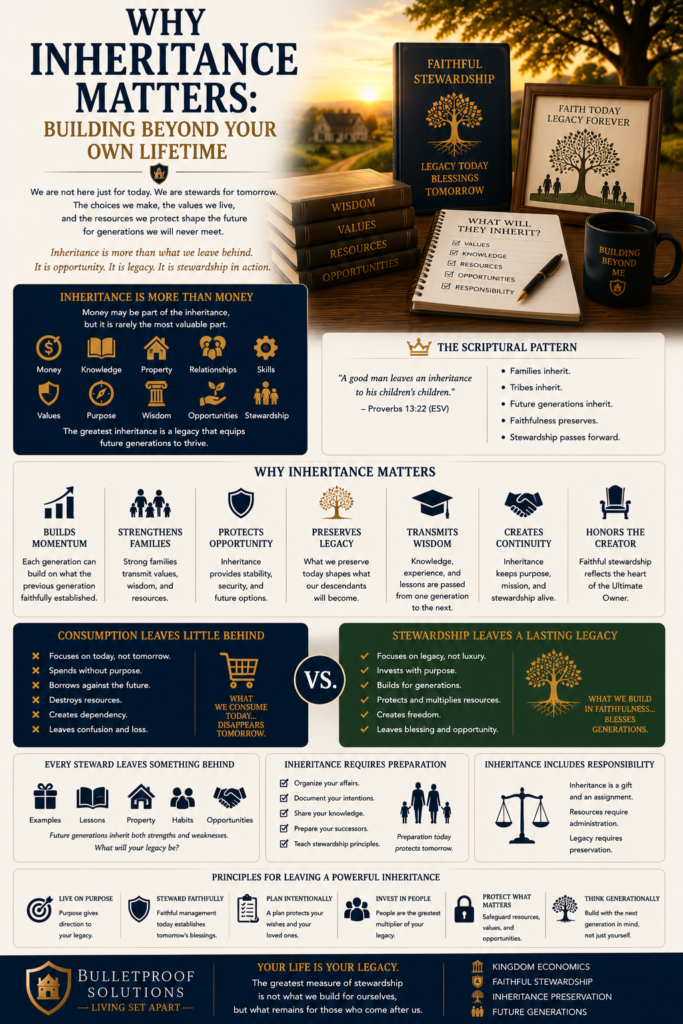
Inheritance is not merely the transfer of property after death.
Inheritance is the transfer of opportunity.
Knowledge.
Wisdom.
Resources.
Relationships.
Responsibility.
Stewardship.
Inheritance allows future generations to begin from a stronger position than the generations that came before.
For this reason, inheritance occupies an important place within Kingdom economics.
No generation starts from nothing.
Every generation inherits something.
Knowledge.
Language.
Culture.
Land.
Resources.
Systems.
Relationships.
Opportunities.
The question is not whether inheritance exists.
The question is what kind of inheritance is being passed forward.
The faithful steward recognizes that every decision contributes to the inheritance future generations will receive.
One of the greatest misconceptions about inheritance is that inheritance simply means receiving money.
Money may be part of an inheritance.
It is rarely the most valuable part.
Many fortunes have disappeared within a generation or two.
Why?
Because financial assets were transferred without transferring wisdom.
Resources were transferred without transferring stewardship.
Money alone rarely creates lasting wealth.
Knowledge.
Character.
Skills.
Values.
Relationships.
Purpose.
These often become the most valuable parts of inheritance.
The faithful steward seeks to pass forward both assets and wisdom.
Some people assume inheritance applies only to wealthy families.
Nothing could be further from the truth.
Every steward leaves something behind.
Examples.
Lessons.
Habits.
Systems.
Property.
Knowledge.
Debt.
Opportunities.
Future generations inherit both strengths and weaknesses.
The faithful steward therefore asks an important question:
What am I creating for those who come after me?
The consumption model focuses on the present.
The inheritance model focuses on continuity.
The consumer asks:
What can I enjoy today?
The steward asks:
What can I preserve tomorrow?
The consumer often measures success through acquisition.
The steward often measures success through preservation and transfer.
These different perspectives produce very different outcomes.
One tends to consume opportunity.
The other tends to multiply opportunity.
One of the greatest benefits of inheritance is momentum.
Each generation does not need to start over.
Knowledge can accumulate.
Resources can accumulate.
Relationships can accumulate.
Infrastructure can accumulate.
Progress can continue.
Without inheritance, much of society would constantly restart from the beginning.
Inheritance allows progress to build upon previous progress.
The faithful steward recognizes that continuity is one of inheritance’s greatest gifts.
Historically, families served as primary inheritance institutions.
Skills were transferred.
Trades were transferred.
Property was transferred.
Wisdom was transferred.
Responsibility was transferred.
Children learned from parents.
Grandchildren learned from grandparents.
Knowledge accumulated across generations.
Strong families became powerful engines of continuity.
The faithful steward seeks to strengthen this process rather than weaken it.
Many people focus exclusively on building wealth.
Far fewer focus on preserving wealth.
Even fewer focus on transferring wealth effectively.
As a result, resources are often accumulated and then lost.
The stewardship model recognizes that wealth becomes far more valuable when it survives beyond the life of the person who created it.
Preservation transforms temporary success into lasting impact.
Inheritance transforms individual achievement into generational opportunity.
Inheritance does not happen automatically.
Assets must be organized.
Documentation must be maintained.
Knowledge must be shared.
Successors must be prepared.
Stewardship principles must be taught.
Without preparation, inheritance often becomes confusion.
The faithful steward therefore plans intentionally.
Preparation protects continuity.
Continuity strengthens inheritance.
Inheritance is not merely receiving benefits.
Inheritance includes responsibility.
Future stewards inherit obligations as well as opportunities.
Resources require administration.
Property requires maintenance.
Knowledge requires application.
Legacy requires preservation.
The faithful steward understands that inheritance is both a gift and an assignment.
Throughout Scripture, inheritance appears repeatedly.
Families inherit.
Tribes inherit.
Future generations inherit.
The emphasis is not merely on possession.
The emphasis is on continuity.
Faithfulness.
Preservation.
Stewardship.
Inheritance serves as a mechanism through which blessings, responsibilities, and opportunities pass from one generation to the next.
This pattern remains central to Kingdom economics.
Within the Kingdom of Heaven Trust Management System, inheritance represents continuity of stewardship.
The Creator remains the ultimate Owner and Settlor.
Stewards administer resources during their appointed season.
Future stewards continue the administration.
The objective is not merely accumulation.
The objective is faithful preservation and transfer.
Resources.
Knowledge.
Communities.
Relationships.
Opportunities.
Inheritance ensures that stewardship continues beyond a single lifetime.
Many modern systems encourage short-term thinking.
Immediate gratification.
Immediate consumption.
Immediate results.
The faithful steward thinks differently.
What will remain?
What will endure?
What will continue after I am gone?
These questions naturally lead toward inheritance.
And inheritance naturally leads toward stewardship.
Inheritance matters because life extends beyond a single generation.
Every steward receives something.
Every steward manages something.
Every steward leaves something behind.
The question is not whether an inheritance will exist.
The question is what kind of inheritance will be passed forward.
The faithful steward therefore focuses not merely on accumulation.
But preservation.
Not merely on ownership.
But transfer.
Not merely on personal success.
But generational continuity.
Because one of the greatest measures of stewardship is not what we build for ourselves.
It is what remains for those who come after us.
Explore Kingdom economics, inheritance preservation, stewardship, trust administration, generational planning, community development, and practical educational resources through the courses, discussions, tools, and community available through BulletProof Solutions.