
Most people are busy.
They have schedules.
Responsibilities.
Obligations.
Deadlines.
Appointments.
Bills.
Commitments.
Their days are filled with activity.
Yet activity and intentionality are not the same thing.
A person can spend an entire lifetime moving from one obligation to the next without ever asking a simple question:
“Am I actually directing my life, or am I merely responding to circumstances?”
This question lies at the heart of intentional living.
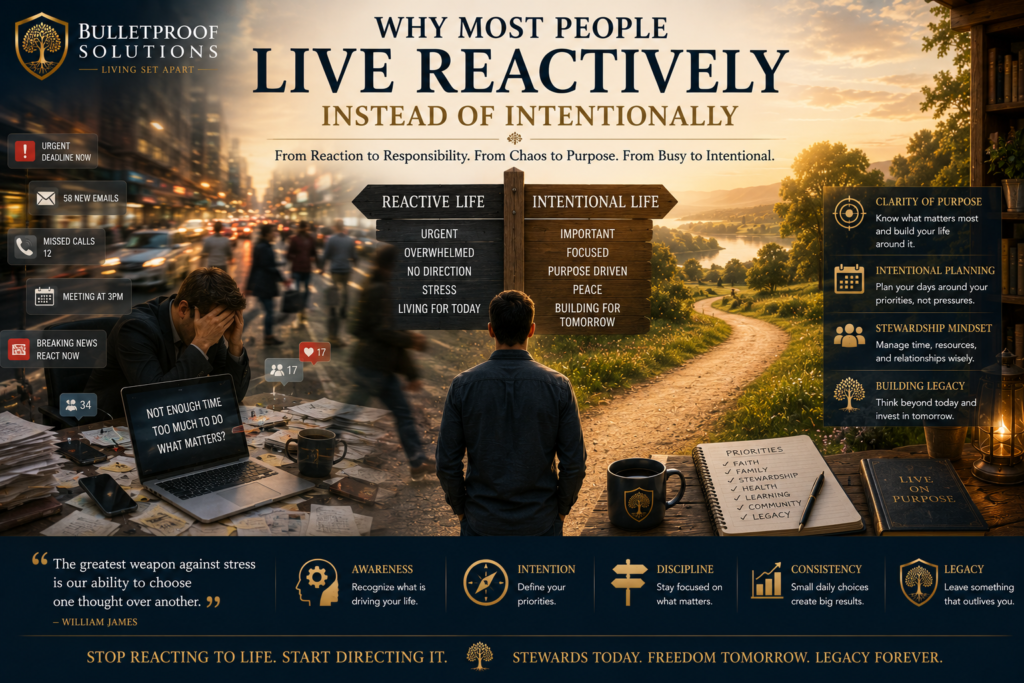
The reality is that most people live reactively.
Not because they want to.
Not because they consciously choose to.
But because reactive living has become the default operating system of modern society.
Understanding why this happens is the first step toward changing it.
Reactive living means responding to whatever demands immediate attention.
The phone rings.
You answer it.
An email arrives.
You respond.
A bill appears.
You pay it.
A crisis emerges.
You deal with it.
None of these actions are inherently wrong.
The problem occurs when reaction becomes the primary mode of operation.
Intentional living operates differently.
An intentional person begins with purpose.
Their actions flow from priorities rather than interruptions.
They decide what matters first.
Then they organize their time, resources, and energy around those priorities.
Reactive living asks:
“What requires my attention right now?”
Intentional living asks:
“What deserves my attention most?”
One question produces motion.
The other produces direction.
Many systems are designed around urgency.
News cycles operate on urgency.
Social media operates on urgency.
Advertising operates on urgency.
Politics operates on urgency.
Modern communication operates on urgency.
Everything competes for attention.
Every platform wants engagement.
Every organization wants participation.
Every issue is presented as though it demands immediate response.
Over time, people become conditioned to react.
Instead of setting priorities, they respond to whoever demands attention the loudest.
This creates a life driven by interruptions.
The result is constant activity with little long-term direction.
Reactive living carries hidden costs.
The first cost is clarity.
People become so busy responding that they rarely stop to evaluate where they are headed.
The second cost is stewardship.
Resources are consumed without intentional planning.
Time disappears.
Opportunities are missed.
Relationships are neglected.
The third cost is peace.
A reactive life often feels chaotic because external circumstances continually dictate internal priorities.
Many people feel exhausted not because they are doing too much, but because they are constantly responding rather than directing.
Without intention, life becomes a series of reactions.
Fear has always been one of the strongest motivators of human behavior.
Fear of loss.
Fear of rejection.
Fear of failure.
Fear of uncertainty.
Fear causes people to focus almost exclusively on immediate threats.
While this response may be useful during genuine emergencies, many people live in a constant state of low-level anxiety.
The result is perpetual reaction.
They never move beyond crisis management.
They never create long-term plans.
They never develop clear priorities.
They simply move from one concern to the next.
Intentional living requires the courage to look beyond immediate fears and focus on long-term stewardship.
One of the defining characteristics of modern culture is convenience.
Convenience saves time.
Convenience reduces effort.
Convenience often improves efficiency.
Yet convenience can become dangerous when it replaces intentionality.
Many people make decisions based solely upon what is easiest rather than what is best.
The easiest option is not always the wisest option.
The fastest solution is not always the most sustainable solution.
The convenient path is not always the most purposeful path.
Intentional living requires the willingness to prioritize purpose over convenience.
Stewardship and reactivity cannot coexist indefinitely.
A steward plans.
A steward prepares.
A steward evaluates.
A steward considers future consequences.
Reactive living focuses primarily on the present.
Stewardship considers both the present and the future.
This principle applies to every area of life.
Financial stewardship requires planning.
Relationship stewardship requires intentional investment.
Community stewardship requires participation.
Educational stewardship requires ongoing learning.
Without intentionality, stewardship becomes difficult.
Without stewardship, long-term growth becomes unlikely.
One of the simplest ways to become more intentional is to begin asking better questions.
Most people ask:
What do I need to do today?
Intentional people often ask:
Why am I doing it?
Most people ask:
How do I solve this problem?
Intentional people often ask:
What created this problem?
Most people ask:
What do I want?
Intentional people often ask:
What am I responsible for?
Questions shape focus.
Focus shapes decisions.
Decisions shape outcomes.
Learning to ask better questions often changes the direction of an entire life.
Intentional people are not guided primarily by emotions, headlines, trends, or external pressure.
They are guided by principles.
Principles provide stability.
Circumstances change.
Principles endure.
Opinions change.
Principles endure.
Trends change.
Principles endure.
A person who lives according to principles possesses an internal compass.
That compass allows them to navigate uncertainty without becoming completely controlled by it.
Living set apart begins when principles become stronger than pressures.
Many people assume intentional living requires dramatic changes.
Usually it does not.
Major transformation often begins with small adjustments.
A few minutes of daily reflection.
Clear priorities.
Intentional planning.
Purposeful conversations.
Consistent learning.
Small decisions repeated consistently over time produce significant results.
The goal is not perfection.
The goal is direction.
Intentional people understand that a degree of progress sustained over many years produces extraordinary outcomes.
Most people do not live reactively because they are lazy.
They live reactively because they have been conditioned to respond rather than direct.
Modern culture rewards reaction.
Stewardship requires intention.
The difference between the two is profound.
Reactive living allows circumstances to determine priorities.
Intentional living establishes priorities before circumstances arrive.
Reactive living focuses on whatever is urgent.
Intentional living focuses on what is important.
Reactive living consumes resources.
Intentional living stewards them.
Living set apart begins when a person chooses to stop drifting and start directing.
It begins when responsibility becomes greater than convenience.
It begins when principles become greater than pressure.
Most importantly, it begins when a person asks a simple question:
“Am I merely reacting to life, or am I intentionally stewarding what has been entrusted to me?”
The answer to that question often changes everything.
Living intentionally is one of the foundational principles of stewardship.
Explore the resources, training, and community available through BulletProof Solutions and continue your journey toward living with greater purpose, responsibility, and intentionality.