
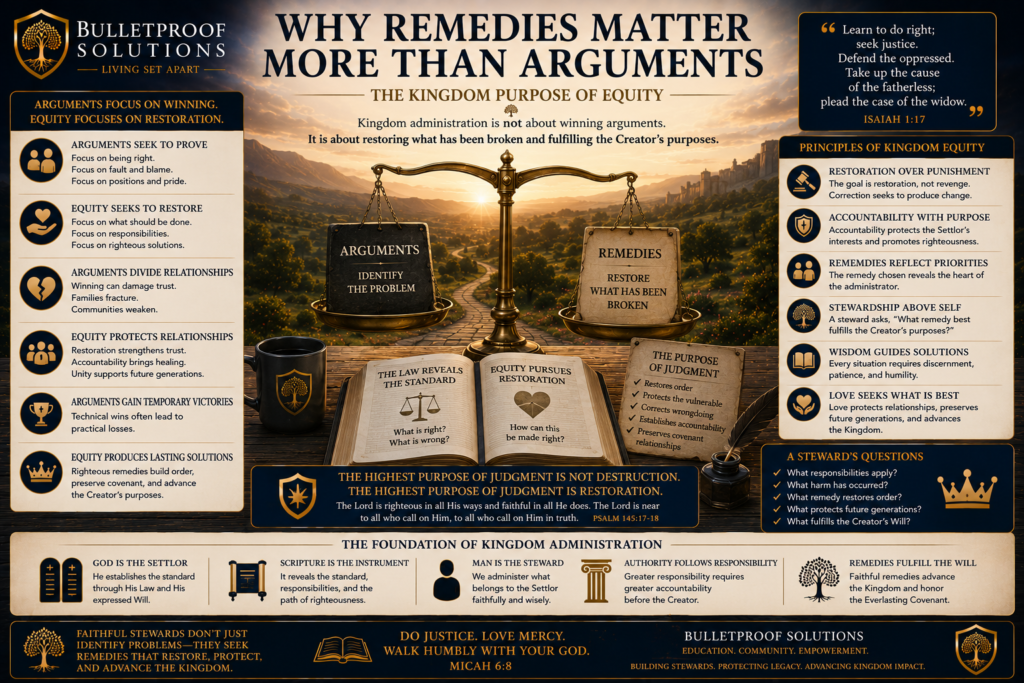
One of the greatest mistakes people make when approaching conflict is focusing on arguments rather than remedies.
They focus on proving they are right.
They focus on proving someone else is wrong.
They focus on technicalities.
Procedures.
Positions.
Opinions.
Yet throughout Scripture, the Creator consistently demonstrates concern for something far more important.
Restoration.
The objective of righteous judgment is not merely determining who is correct.
The objective is restoring what has been broken.
This principle lies at the heart of Kingdom administration.
It also lies at the heart of equity.
Many people think equity is simply a legal concept.
In reality, equity reflects something much deeper.
Equity reflects the pursuit of righteous remedies that restore order, fulfill responsibilities, and protect those entrusted to our care.
Within the Kingdom of Heaven Trust Management System, equity is understood as one of the administrative mechanisms through which faithful stewards execute the Creator’s Will.
When most people hear the word judgment, they immediately think of punishment.
While judgment may involve consequences, Scripture repeatedly demonstrates that judgment serves a broader purpose.
Judgment restores order.
Judgment protects the vulnerable.
Judgment corrects wrongdoing.
Judgment establishes accountability.
Judgment preserves covenant relationships.
Throughout Scripture, righteous judges were expected to protect widows, orphans, strangers, and those who lacked power.
The focus was not merely punishment.
The focus was restoration and justice.
This remains one of the defining characteristics of Kingdom judgment.
The Creator’s Law establishes standards.
It reveals what is right.
It reveals what is wrong.
It establishes boundaries.
It provides guidance for faithful administration.
Without standards there can be no accountability.
Without accountability there can be no meaningful stewardship.
The Law therefore serves an essential purpose.
It reveals the Creator’s expectations.
However, identifying the standard is only the beginning.
A second question remains.
What should be done when the standard has been violated?
This is where remedies become important.
Law reveals the standard.
Equity seeks restoration.
Equity asks questions such as:
How can this be made right?
How can responsibilities be fulfilled?
How can trust be restored?
How can harm be corrected?
How can covenant relationships be preserved?
These questions move beyond technical violations.
They focus upon solutions.
The steward seeks remedies because the steward seeks restoration.
The objective is not merely proving fault.
The objective is faithfully administering a solution.
Throughout Scripture we see a recurring pattern.
The Creator identifies wrongdoing.
The Creator establishes accountability.
The Creator provides a path toward restoration.
Even discipline itself frequently serves restorative purposes.
Correction is intended to produce change.
Judgment is intended to restore order.
Accountability is intended to produce righteousness.
This pattern reveals an important Kingdom principle.
The highest purpose of judgment is not destruction.
The highest purpose of judgment is restoration.
Faithful stewards should therefore approach conflict with restoration in mind.
The remedy chosen often reveals the priorities of the administrator.
An administrator focused upon punishment seeks punishment.
An administrator focused upon restoration seeks restoration.
An administrator focused upon stewardship seeks accountability and correction.
This distinction matters.
Kingdom administration is not driven by revenge.
It is driven by stewardship.
The faithful steward asks:
What remedy best fulfills the Creator’s purposes?
What remedy restores order?
What remedy protects future generations?
What remedy preserves covenant relationships where possible?
These questions help ensure that remedies remain aligned with Kingdom objectives.
One reason equity matters so deeply is because relationships matter.
Property can be replaced.
Money can often be recovered.
Relationships are far more difficult to restore once destroyed.
Many disputes involve relationships of trust.
Families.
Communities.
Fellowships.
Trust relationships.
Stewardship relationships.
The faithful administrator therefore considers not only the immediate dispute but also the long-term impact upon relationships.
This perspective frequently produces better outcomes than approaches focused solely upon winning arguments.
Within KOHTMS, every administrator is first a steward.
A steward manages what belongs to another.
A steward protects the interests of the Settlor.
A steward executes the expressed Will of the Creator.
This perspective changes how disputes are viewed.
The question is no longer:
How do I win?
The question becomes:
How do I faithfully administer what has been entrusted to me?
The steward seeks remedies because remedies solve problems.
Arguments alone rarely do.
Many people win arguments and lose everything that matters.
Families become divided.
Communities fracture.
Trust disappears.
Future cooperation becomes impossible.
The technical victory produces practical failure.
Kingdom administration seeks something better.
Faithful administration seeks outcomes that restore righteousness, accountability, and stewardship.
This does not mean wrongdoing is ignored.
It means remedies remain focused upon solving the underlying problem.
Not every situation requires the same remedy.
Wisdom becomes essential.
A wise steward evaluates:
The relationships involved.
The responsibilities involved.
The harm that occurred.
The opportunities for restoration.
The protection of future interests.
This requires discernment.
It requires patience.
It requires humility.
Most importantly, it requires commitment to executing the Creator’s Will rather than merely personal preferences.
The Kingdom of Heaven is not administered through technicalities alone.
It is administered through righteousness, justice, mercy, accountability, and stewardship.
Law reveals the standard.
Equity helps faithfully apply the standard.
Together they support righteous administration.
Separated from one another, both become incomplete.
The steward therefore learns to appreciate both.
The standard matters.
The remedy matters as well.
Many people spend enormous energy arguing about who is right.
Far fewer invest equal energy identifying remedies that restore what has been broken.
Kingdom administration requires both truth and restoration.
Law reveals the truth.
Equity pursues restoration.
The faithful steward understands that the purpose of administration is not simply to identify wrongdoing.
The purpose is to restore order, protect relationships, preserve stewardship, and execute the Creator’s expressed Will.
For this reason, remedies often matter more than arguments.
Arguments may identify the problem.
Faithful remedies help solve it.
And solving problems through righteous stewardship remains one of the highest responsibilities entrusted to Kingdom administrators.
The Kingdom of Heaven Trust Management System provides a framework for understanding stewardship, administration, equity, covenant, and faithful execution of the Creator’s Will.
Explore the resources, discussions, training, and community available through BulletProof Solutions and continue developing as a faithful steward within the Everlasting Covenant.