
Many people encounter trusts for the first time through paperwork.
A trust agreement.
A declaration.
An estate plan.
A legal document.
As a result, they often assume trusts exist because of laws, regulations, or technical legal requirements.
In reality, the structure came long after the purpose.
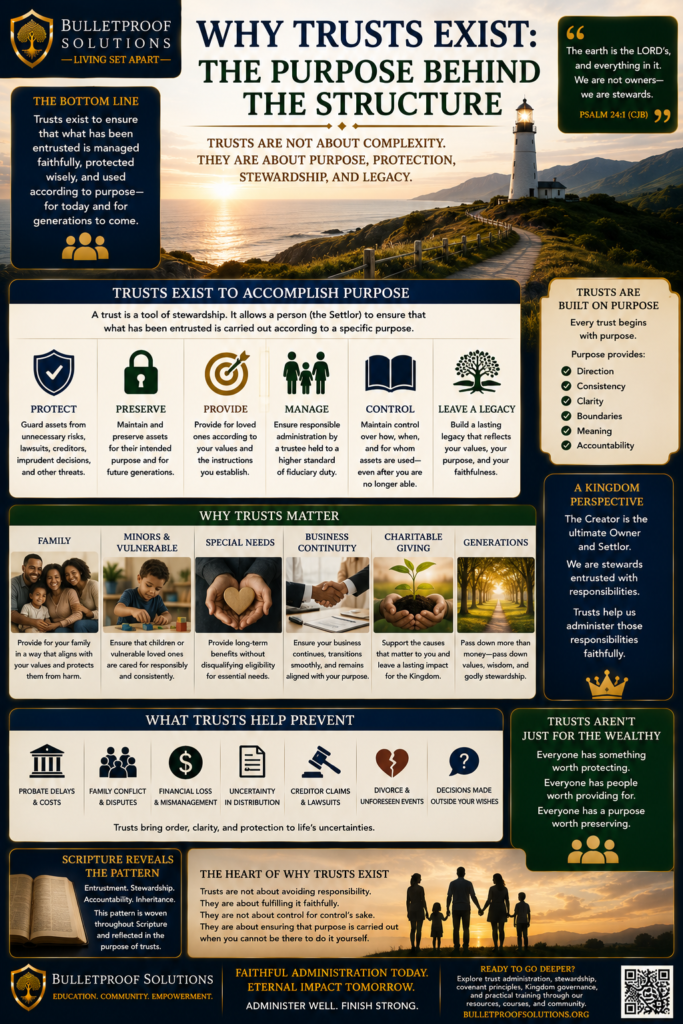
Trusts exist because human beings needed a reliable way to preserve, protect, administer, and transfer responsibilities, resources, and inheritance.
The documents merely record the arrangement.
The purpose came first.
To truly understand trusts, we must look beyond the paperwork and examine the reason trusts exist at all.
Because a trust is not fundamentally about documents.
It is about purpose.
Throughout history, people have faced a common challenge.
How do you ensure that something valuable is properly administered when you cannot personally oversee it?
The challenge appears in many forms.
A parent wants to provide for children.
A family wants to preserve inheritance.
A business owner wants continuity.
A community wants resources managed responsibly.
A benefactor wants a charitable mission to continue.
A steward wants instructions followed faithfully.
In each case, the problem is the same.
How can purpose survive beyond the direct involvement of the person who established it?
Trusts developed as one answer to that question.
At their core, trusts are stewardship structures.
Something valuable has been entrusted.
Someone must administer it.
Instructions must be followed.
Accountability must exist.
The trust relationship creates a framework for carrying out these responsibilities.
Without stewardship, resources are often consumed.
Without stewardship, inheritance is often lost.
Without stewardship, purpose often disappears.
Trusts exist to strengthen faithful administration.
Purpose is the heart of every trust.
Without purpose, the trust becomes meaningless.
The Settlor establishes the purpose.
The Trustee administers according to the purpose.
The Beneficiary receives benefits flowing from the purpose.
Everything revolves around that central objective.
The trust structure exists to ensure that purpose remains intact over time.
This is one reason trusts often outlive the individuals who created them.
Purpose continues even when people change.
Protection is another important reason trusts exist.
Throughout life, people accumulate responsibilities.
Resources.
Property.
Opportunities.
Knowledge.
Relationships.
Inheritance.
These things often require protection.
Not merely from external threats.
But from mismanagement.
Confusion.
Conflict.
Neglect.
Poor administration.
Trust structures help create order around what has been entrusted.
That order strengthens protection.
One of the greatest challenges in administration is continuity.
People age.
People relocate.
People become incapacitated.
People die.
Yet responsibilities often remain.
Families continue.
Businesses continue.
Communities continue.
Future generations continue.
Trusts provide continuity by creating a framework that survives changes in individual administrators.
The purpose remains.
The instructions remain.
The administration continues.
This continuity is one of the greatest strengths of the trust relationship.
Many organizations fail because everything depends upon a single individual.
When that individual leaves, the purpose collapses.
Trusts help solve this problem.
The purpose becomes larger than any one person.
The Settlor establishes it.
The Trustee administers it.
Successor Trustees may continue it.
Beneficiaries continue receiving benefits from it.
The structure allows the purpose to survive beyond the personality of any particular administrator.
Inheritance involves far more than money.
Inheritance includes:
Values.
Knowledge.
Opportunities.
Resources.
Responsibilities.
Relationships.
Vision.
Mission.
The faithful steward thinks generationally.
Not merely about personal benefit.
But about what will remain for future generations.
Trusts provide a framework for preserving and transferring inheritance according to established purposes.
This makes them powerful tools for long-term stewardship.
Every entrusted responsibility requires accountability.
Without accountability, administration often becomes arbitrary.
Trusts help establish clear expectations.
Clear responsibilities.
Clear duties.
Clear standards.
The Trustee becomes accountable to the purpose of the trust.
The administration becomes subject to review.
The structure encourages faithful conduct.
Trusts therefore help strengthen responsible administration.
Conflict often arises when expectations are unclear.
Who controls what?
Who benefits?
Who makes decisions?
What is the purpose?
What instructions apply?
Trusts help answer these questions in advance.
Clarity reduces uncertainty.
Purpose reduces confusion.
Instructions reduce disputes.
While no structure eliminates all conflict, trusts often provide a framework that helps resolve uncertainty before it becomes a problem.
One of the most important realities trust structures recognize is that human administration is temporary.
Every steward serves for a season.
Every administrator eventually leaves the position.
Every generation eventually passes responsibility to the next.
Trusts acknowledge this reality.
The structure is designed to preserve purpose beyond the life of any single administrator.
In this way, trusts reflect the generational nature of stewardship itself.
The principles underlying trusts appear repeatedly throughout Scripture.
Entrustment.
Stewardship.
Administration.
Accountability.
Inheritance.
Faithful management.
The Creator repeatedly entrusts responsibilities to people.
Those responsibilities are administered according to instructions.
Future generations benefit from faithful administration.
While Scripture may not always use modern trust terminology, the underlying principles appear consistently.
The pattern is ancient.
One of the greatest mistakes people make is focusing entirely on the structure.
The document.
The language.
The mechanics.
The procedures.
These things matter.
But they are not the reason the trust exists.
The structure serves the purpose.
The purpose does not serve the structure.
When purpose is forgotten, administration often loses direction.
The faithful steward always returns to the question:
Why was this trust established?
The answer provides guidance for every other decision.
Within the Kingdom of Heaven Trust Management System, trusts are understood first as stewardship relationships.
The Creator remains the ultimate Settlor.
The Everlasting Covenant establishes the relationship.
The Word provides the instructions.
Human beings function as stewards and trustees of what has been entrusted.
The trust exists to ensure faithful administration according to purpose.
This perspective places stewardship at the center of trust administration.
Not ownership.
Not control.
Not complexity.
Stewardship.
Many people spend enormous amounts of time learning trust mechanics while never understanding trust purpose.
As a result, the structure becomes more important than the reason for its existence.
The faithful steward approaches trusts differently.
The steward begins with purpose.
Purpose determines administration.
Administration determines stewardship.
Stewardship determines inheritance.
When the purpose is clear, the structure becomes far easier to understand.
Trusts exist because purpose matters.
Trusts exist because stewardship matters.
Trusts exist because inheritance matters.
Trusts exist because faithful administration matters.
They provide a framework for protecting what has been entrusted.
Preserving purpose.
Maintaining continuity.
Reducing conflict.
Strengthening accountability.
And transferring inheritance according to established instructions.
The documents may record the arrangement.
The structure may facilitate the administration.
But neither represents the true reason trusts exist.
Trusts exist because something valuable deserves faithful stewardship.
And when stewardship is faithful, purpose survives, inheritance endures, and future generations benefit from the wisdom of those who came before them.
Explore trust administration, stewardship, trusteeship, inheritance, covenant principles, Kingdom governance, and practical trust estate education through the educational resources, discussions, training programs, and community available through BulletProof Solutions.