
Category
Trust Estate Foundations
Reading Time
Approximately 15–18 minutes
Supports Learning Path
Trust Estate Foundations
Featured Course
Defending and Bringing Claims on Behalf of Your Trust Estate
Free Seminar
Defending Your Trust Estate (Available)
Key Topics
One of the greatest misconceptions about trusts is the belief that a trustee’s responsibilities begin and end with holding property.
In reality, holding property is only one part of the trustee’s role.
The trustee is a fiduciary.
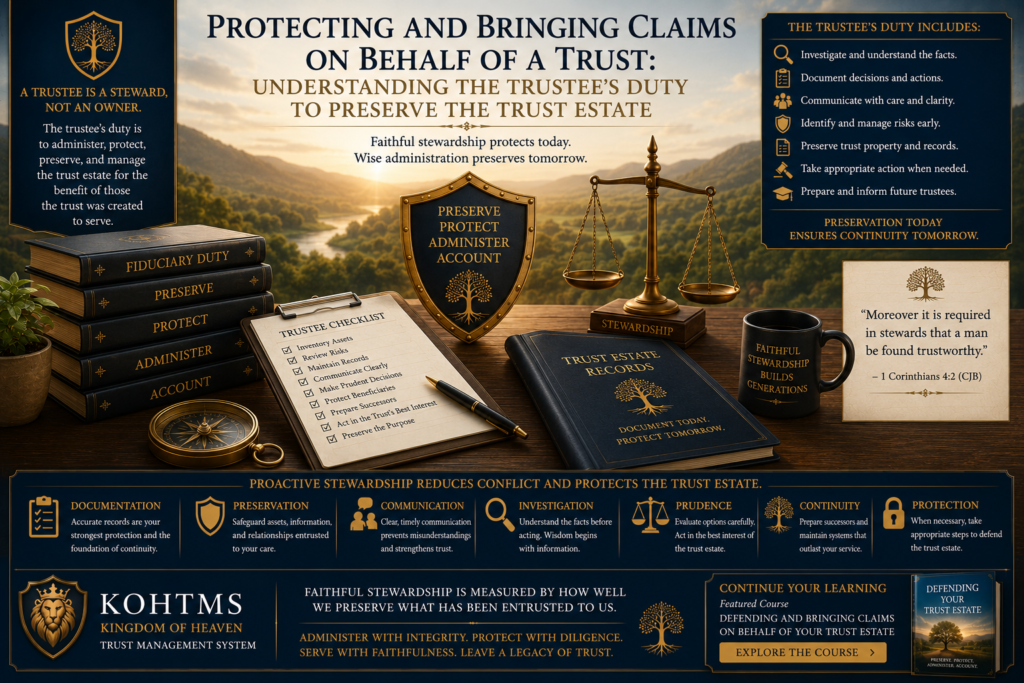
That means the trustee accepts the responsibility of faithfully administering, protecting, preserving, and managing the trust estate for the benefit of those whom the trust was created to serve.
Faithful administration requires more than passive oversight.
It requires vigilance.
Wisdom.
Preparation.
Documentation.
And, when circumstances require, appropriate action to protect the interests entrusted to the trust.
The trustee is not merely a holder of assets.
The trustee is the steward of an entire system of administration.
Every trust is created for a purpose.
Whatever that purpose may be, it depends upon preserving the trust estate.
Property that is neglected cannot continue serving future generations.
Business operations that are ignored eventually deteriorate.
Administrative records that disappear weaken continuity.
Relationships that remain unattended often suffer unnecessary conflict.
Faithful stewardship therefore begins with preservation.
The trustee continually asks:
“How do I preserve what has been entrusted to my care?”
That question guides every administrative decision.
Protection does not begin only after problems arise.
Good trustees think proactively.
They identify risks before those risks become losses.
They maintain records before questions arise.
They review agreements before disagreements occur.
They verify ownership before disputes develop.
Protection is therefore not a single event.
It is an ongoing administrative discipline.
Strong administration reduces many conflicts before they ever occur.
One of the trustee’s greatest tools is accurate documentation.
Good records preserve institutional memory.
They explain why decisions were made.
They demonstrate faithful administration.
They provide continuity for successor trustees.
They strengthen accountability.
Documentation should include matters such as:
The faithful trustee documents consistently because future stewardship depends upon today’s records.
Occasionally circumstances arise where the interests of the trust require affirmative action.
Examples may include disputes regarding trust property, questions concerning contractual rights, disagreements over administration, or efforts to preserve assets entrusted to the trust.
In such situations, the trustee’s responsibility is not to pursue conflict for its own sake.
Rather, the trustee must thoughtfully evaluate how to protect the trust estate consistent with the trustee’s fiduciary duties and the purposes of the trust.
The appropriate response depends on the facts, the governing documents, and applicable law.
Faithful trustees do not react impulsively.
Before acting, they seek to understand the facts.
Questions may include:
Careful investigation supports sound decision-making.
Well-informed administration is almost always better than hurried administration.
Many trust disagreements begin with misunderstanding rather than misconduct.
Faithful communication often prevents unnecessary conflict.
Appropriate communication may involve:
Clear communication promotes confidence.
Confidence strengthens trust relationships.
Not every problem requires immediate action.
Not every disagreement requires formal proceedings.
Faithful trustees exercise judgment.
They evaluate available information.
They consider the interests of all beneficiaries.
They weigh potential consequences.
They seek solutions consistent with faithful stewardship.
Prudence often proves to be one of a trustee’s greatest strengths.
Within the Kingdom of Heaven Trust Management System, the preferred objective is preservation.
Good administration.
Faithful documentation.
Responsible communication.
Thoughtful planning.
Risk reduction.
These practices often prevent many disputes before they arise.
The strongest trust is frequently the one that never needs to defend itself because it has been faithfully administered from the beginning.
There are occasions when faithful administration requires difficult decisions.
A trustee may need to protect trust property.
Clarify administrative authority.
Address breaches of fiduciary duty.
Preserve important records.
Or take other appropriate steps to fulfill the trustee’s obligations.
Faithful stewardship sometimes requires courage.
Not because conflict is desired.
But because the trust deserves faithful administration.
Every protective measure taken today strengthens tomorrow’s administration.
Organized records.
Clear procedures.
Well-documented decisions.
Thoughtful succession planning.
These become invaluable resources for future trustees who inherit responsibility for continuing the trust’s purpose.
The faithful trustee always administers with the next generation in mind.
Throughout Scripture, faithful stewards are consistently portrayed as watchful caretakers.
They protect what has been entrusted to them.
They account faithfully.
They prepare successors.
They act responsibly.
Their faithfulness is measured not simply by what they possess but by how diligently they preserve what has been entrusted to their care.
This pattern reflects the trustee’s calling to serve with wisdom, integrity, and vigilance.
Within the Kingdom of Heaven Trust Management System, protection is understood as an essential part of administration.
The trustee is not merely preserving assets.
The trustee is preserving purpose.
Every record maintained.
Every decision documented.
Every responsibility faithfully carried out.
Every risk thoughtfully managed.
Together these actions strengthen the trust estate and prepare it to continue serving future generations.
Protection is therefore not separate from stewardship.
It is stewardship in action.
Modern trust administration often focuses on documents while overlooking the daily work of preservation.
Yet the health of a trust depends less upon the documents that created it than upon the faithfulness with which it is administered.
Protection begins long before problems arise.
It begins with faithful stewardship practiced consistently over time.
Protecting a trust estate is far more than responding to disputes.
It is the daily work of faithful administration.
The trustee preserves property.
Maintains records.
Evaluates risks.
Communicates responsibly.
Documents decisions.
Prepares successors.
And, when appropriate, acts to safeguard the interests entrusted to the trust.
The faithful trustee understands that stewardship is measured not merely by what has been received but by what has been faithfully preserved.
Because every act of responsible administration strengthens the trust today and protects its ability to serve tomorrow.
If this article helped you understand the trustee’s duty to preserve and protect the trust estate, these resources will help you explore those responsibilities in greater depth.
Explore fiduciary obligations, trust preservation, administrative documentation, risk management, representative authority, and the trustee’s role in protecting the interests of the trust estate through faithful stewardship and sound administration.
Defending Your Trust Estate – Free Seminar
Watch the introductory seminar exploring practical trust preservation, fiduciary responsibilities, administrative protection, and stewardship principles.
Next Article
The Three Essential Parties to Every Trust: Understanding the Roles of the Settlor, Trustee, and Beneficiary