
Category
Trust Estate Foundations
Reading Time
Approximately 15–18 minutes
Supports Learning Path
Trust Estate Foundations
Featured Course
Establishing Your Trust Estate
Free Seminar
Establishing Your Trust Estate (Available)
Key Topics
One of the most common misunderstandings about trusts is the belief that one trust should hold everything.
For some people, a single trust may adequately accomplish their objectives.
For others, attempting to place every asset, every business, every responsibility, and every future plan into one trust may create unnecessary complexity.
The faithful steward approaches the question differently.
Rather than asking,
“What trust should I create?”
the faithful steward first asks,
“What am I trying to administer?”
That question changes everything.
Instead of beginning with trust documents, it begins with purpose.
Instead of beginning with legal forms, it begins with stewardship.
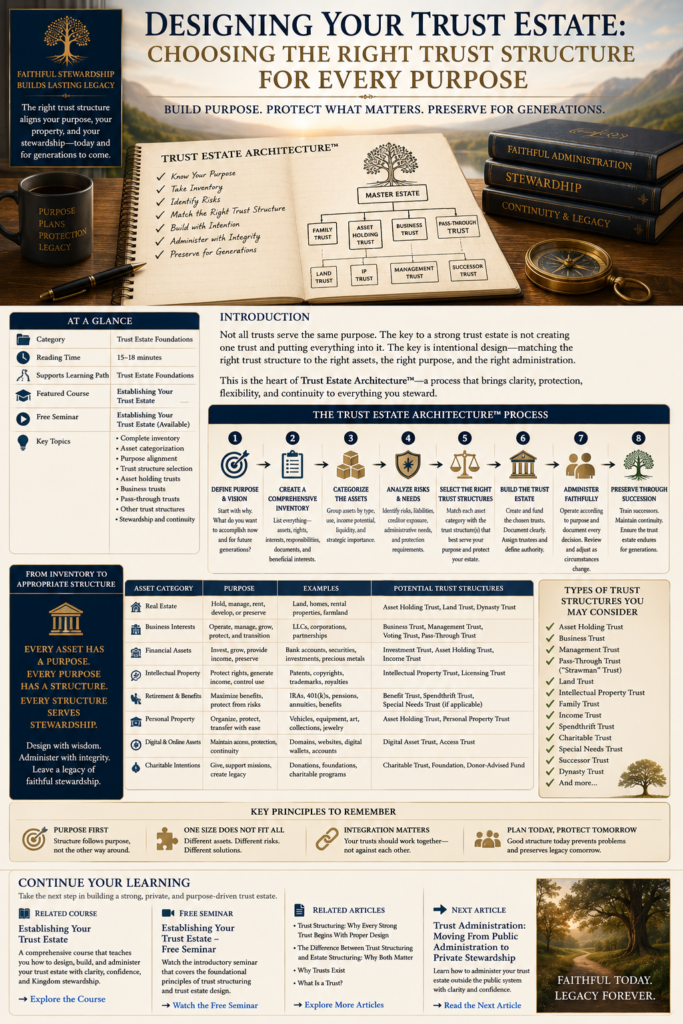
This is the foundation of what we refer to within the Kingdom of Heaven Trust Management System as Trust Estate Architecture—the intentional design of a trust estate by aligning purpose, property, responsibility, and administration into one coherent stewardship framework.
Every structure exists to accomplish something.
A business exists to conduct commerce.
A family exists to nurture relationships across generations.
A ministry exists to serve.
A trust exists to administer.
When purpose is unclear, structure often becomes inefficient.
When purpose is clearly defined, structure becomes much easier to design.
Purpose is therefore the first decision—not the last.
The faithful steward never begins by asking what documents to prepare.
The faithful steward begins by understanding what responsibilities require administration.
Before selecting trust structures, develop a complete inventory of everything that makes up the trust estate.
This inventory should include far more than physical assets.
Examples include:
Every item entrusted to your stewardship deserves thoughtful consideration.
The objective is not merely to identify ownership.
The objective is to identify what must be faithfully administered.
Once the inventory is complete, organize it into functional categories.
For example:
Grouping similar assets often reveals common administrative needs.
Those needs help determine the most appropriate trust structures.
Each category presents different responsibilities.
Questions may include:
Who will administer these assets?
Will decisions require specialized knowledge?
Will multiple generations become involved?
Will operations continue after the current trustee is gone?
Does the property require active management or long-term preservation?
The answers often reveal that different portions of the estate benefit from different administrative structures.
Now the question becomes:
“What trust structure best supports the administration of this category?”
For example, an estate might include:
An operating business.
Income-producing real estate.
Family heirlooms.
Intellectual property.
Investment assets.
Charitable activities.
Although each belongs within the larger trust estate, they may have different administrative requirements.
Rather than forcing every responsibility into one structure, the faithful steward considers whether multiple trust relationships better support faithful administration.
The objective is not complexity.
The objective is clarity.
One of the most important concepts to understand is that trusts are administrative tools.
They exist to facilitate faithful stewardship.
They organize responsibility.
They define fiduciary authority.
They preserve continuity.
Different trust structures may therefore exist because different responsibilities require different forms of administration.
The trust serves the purpose.
The purpose does not serve the trust.
Trust Estate Architecture is the process of intentionally designing how an estate will be administered.
It asks questions such as:
What responsibilities exist?
How should those responsibilities be organized?
What structure best supports each responsibility?
How should authority be delegated?
How will continuity be preserved?
How will future trustees understand the system?
Rather than creating isolated trusts, Trust Estate Architecture creates an integrated stewardship framework.
Every trust serves the larger estate.
Every administrative relationship supports faithful stewardship.
Many people assume that one estate requires one trust.
Sometimes that may be appropriate.
Other situations may benefit from multiple administrative structures serving distinct purposes.
For example, different administrative frameworks may be established for:
The appropriate structure depends upon the purpose, complexity, and administrative needs of the estate.
The faithful steward begins with those needs rather than assuming a single structure fits every circumstance.
Good architecture anticipates future change.
Families grow.
Businesses evolve.
Property changes.
Responsibilities expand.
Future generations assume leadership.
Strong trust estate architecture creates systems capable of adapting while preserving continuity.
The objective is stability without unnecessary rigidity.
Throughout Scripture, stewardship consistently reflects thoughtful organization.
Responsibilities are assigned.
Resources are accounted for.
Leaders are appointed.
Successors are prepared.
Administration is intentional rather than accidental.
This pattern reminds us that faithful stewardship involves careful planning as well as faithful execution.
Within the Kingdom of Heaven Trust Management System, Trust Estate Architecture begins with stewardship rather than paperwork.
Purpose determines structure.
Structure supports administration.
Administration preserves continuity.
Future generations inherit not merely assets but organized systems of faithful stewardship.
The Creator remains the ultimate Owner.
Stewards faithfully administer what has been entrusted to their care.
Every structural decision should support that calling.
Modern discussions about trusts often focus on isolated documents.
The stewardship model focuses on systems.
Well-designed systems reduce confusion.
Clarify responsibilities.
Strengthen accountability.
Protect continuity.
Prepare future generations.
The result is not simply a collection of trusts.
It is an intentionally designed trust estate capable of faithful administration across changing circumstances.
Designing a trust estate begins with understanding what has been entrusted to your care.
Every responsibility deserves thoughtful administration.
Every asset deserves appropriate stewardship.
Every trust should exist because it fulfills a clearly defined purpose.
The faithful steward does not begin by asking which document to prepare.
The faithful steward begins by understanding the responsibilities that require administration.
From that understanding emerges a trust estate designed with clarity.
Structured with purpose.
Administered with integrity.
And prepared to serve future generations through faithful stewardship.
If this article helped you understand how Trust Estate Architecture organizes stewardship through purpose-driven design, the following resources expand upon these principles.
Learn how to design, structure, and administer a trust estate by applying stewardship principles, fiduciary relationships, trust architecture, and long-term continuity planning.
Establishing Your Trust Estate – Free Seminar
Watch the introductory seminar exploring trust structuring, estate design, fiduciary administration, and the foundational principles behind building a well-organized trust estate.