
Category
Trust Estate Foundations
Reading Time
Approximately 12–15 minutes
Supports Learning Path
Trust Estate Foundations
Featured Course
Establishing Your Trust Estate
Free Seminar
Establishing Your Trust Estate
Key Topics
Many people believe that a trust begins when documents are signed.
In reality, a well-designed trust begins much earlier.
It begins with purpose.
Before property is transferred…
Before trustees are appointed…
Before beneficiaries are identified…
Someone must first answer a far more important question:
“Why is this trust being created?”
Without a clearly defined purpose, even the most carefully drafted trust documents may fail to accomplish their intended objectives.
Structure exists to serve purpose.
Purpose gives meaning to structure.
Understanding this relationship is one of the most important principles of successful trust administration.
When people hear the phrase “trust structuring,” they often think about legal forms.
Declarations.
Schedules.
Certificates.
Assignments.
While documentation certainly has an important role, documents are only one part of a properly structured trust.
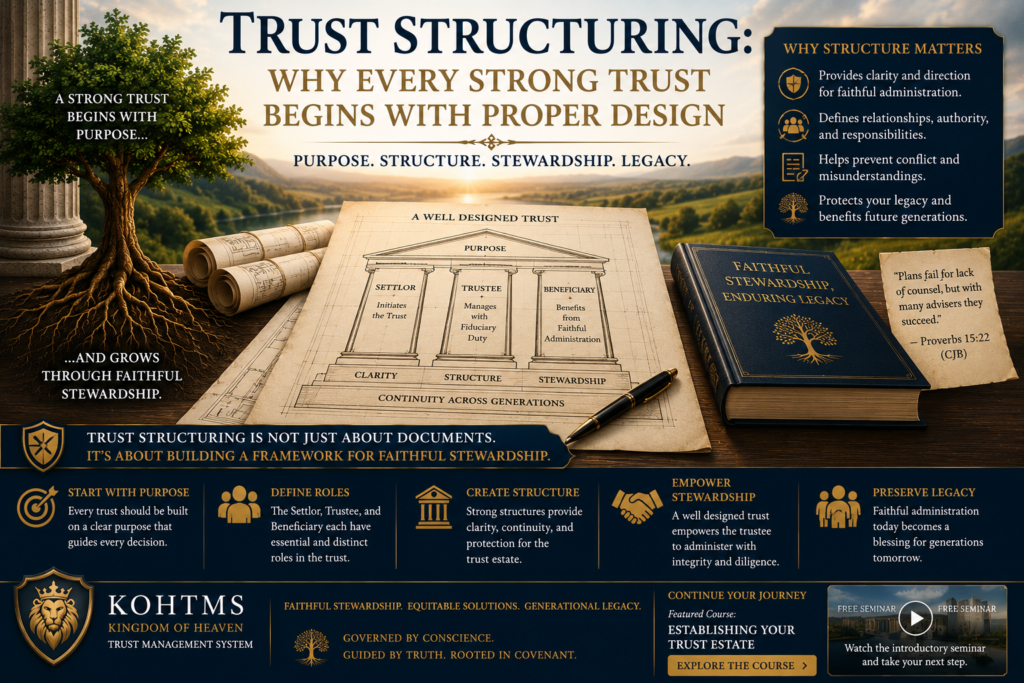
A trust structure is the framework through which stewardship is carried out.
It establishes relationships.
Responsibilities.
Authority.
Accountability.
Continuity.
Administration.
In many ways, trust structuring resembles the architectural design of a building.
The visible portions matter.
The unseen framework matters even more.
A beautiful building constructed upon a weak foundation will eventually fail.
Likewise, a trust lacking proper structure often encounters avoidable problems regardless of how well the documents are drafted.
Every trust should answer several foundational questions before property is ever transferred.
Why does this trust exist?
What responsibilities will it fulfill?
Who will administer those responsibilities?
Who will benefit from faithful administration?
How will continuity be maintained across future generations?
These questions shape every structural decision that follows.
Without clear answers, documents become disconnected from purpose.
The faithful steward understands that purpose always comes before paperwork.
A trust is not merely a collection of assets.
It is a relationship.
More accurately, it is a collection of relationships.
The relationship between the settlor and the trustee.
The relationship between the trustee and the beneficiaries.
The relationship between the trustee and the trust property.
The relationship between present administration and future generations.
Strong structures strengthen these relationships.
Weak structures create uncertainty.
The most effective trust structures begin by clearly defining these relationships before defining procedures.
One of the greatest benefits of proper trust structuring is clarity.
Who has authority?
Who has responsibility?
Who makes decisions?
How are decisions documented?
How are disagreements resolved?
How is continuity preserved?
Clear structure reduces confusion.
Clear structure strengthens accountability.
Clear structure supports faithful stewardship.
When expectations are understood, administration becomes more consistent and predictable.
Many trust problems blamed on “administration” actually originate during the structuring process.
Unclear trustee authority.
Undefined responsibilities.
Poor succession planning.
Incomplete documentation.
Conflicting expectations.
Each of these often reflects structural issues rather than administrative failures.
Faithful administration depends upon faithful design.
A strong structure does not mean rigid administration.
Life changes.
Families grow.
Circumstances evolve.
Good trust structures provide enough stability to preserve continuity while allowing sufficient flexibility to adapt responsibly to changing conditions.
The objective is neither rigidity nor uncertainty.
It is thoughtful stewardship.
Within the Kingdom of Heaven Trust Management System, trust structuring begins with stewardship.
Property is entrusted.
Responsibilities are accepted.
Authority is exercised for the benefit of others.
The trust exists to facilitate faithful administration.
Documents support stewardship.
They do not replace it.
This perspective shifts attention away from ownership and toward responsibility.
Many trust difficulties can be traced to avoidable design decisions.
Examples include:
These challenges often arise because attention was focused upon documents rather than structure.
Throughout Scripture, important works begin with preparation.
The builder first counts the cost.
The steward first understands the responsibility.
The foundation is laid before the structure rises.
The pattern teaches that careful preparation often determines long-term success.
Trust structuring follows the same principle.
Wise preparation strengthens faithful administration.
Modern discussions about trusts often focus on documents, taxation, or asset ownership.
While these subjects have their place, they represent only part of the picture.
Proper trust structuring asks deeper questions.
How will this trust function?
Who will administer it?
How will future generations benefit?
How will faithful stewardship be preserved?
Answering these questions before drafting documents creates stronger structures capable of serving their intended purpose for many years to come.
Trust structuring is not merely about preparing documents.
It is about designing a framework for faithful stewardship.
Strong structures create clear relationships.
Clear relationships strengthen administration.
Faithful administration preserves trust.
Trust preserves continuity.
Continuity protects future generations.
The faithful steward understands that every lasting trust begins not with paperwork, but with purpose.
Because when the structure is sound, administration becomes clearer, stewardship becomes stronger, and the trust is better prepared to fulfill the responsibilities for which it was created.
If this article helped you understand the importance of trust structuring, these additional resources will help you build a deeper understanding of trust administration and stewardship.
Learn how trust structuring, fiduciary relationships, stewardship, administration, and long-term continuity work together to form a well-designed trust estate. This comprehensive course expands on the principles introduced in this article with detailed lessons, practical examples, and implementation guidance.
Establishing Your Trust Estate – Free Seminar
Watch the introductory seminar exploring the foundational concepts of trust structuring and trust estate formation.
Next Article
Trust Administration: Moving From Public Administration to Private Stewardship