
Category
Trust Estate Foundations
Reading Time
Approximately 15–18 minutes
Supports Learning Path
Trust Estate Foundations
Featured Course
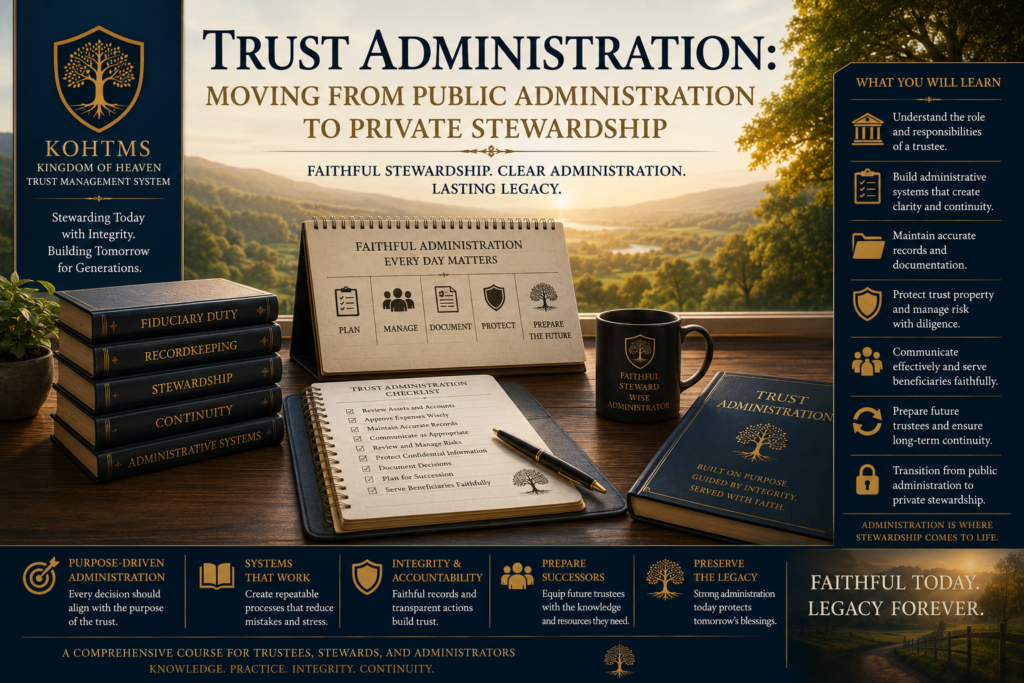
Administrating Your Trust Estate – From Public to Private
Free Seminar
Administrating Your Trust Estate (Available)
Key Topics
Creating a trust is only the beginning.
A carefully designed trust that is never faithfully administered is much like a beautifully constructed ship that never leaves the harbor.
Its design may be impressive.
Its potential may be enormous.
Yet without faithful administration, it never accomplishes the purpose for which it was created.
This is one of the greatest misunderstandings surrounding trusts.
Many people devote tremendous attention to creating trust documents while giving comparatively little thought to the ongoing work of administration.
In reality, administration is where stewardship comes to life.
The trust structure establishes the framework.
Administration fulfills the mission.
Understanding that distinction transforms how we view both trusts and stewardship.
A trust is not a one-time event.
It is an ongoing fiduciary relationship.
The trustee accepts continuing responsibilities.
Decisions must be made.
Records must be maintained.
Property must be preserved.
Beneficiaries must be considered.
Future trustees must be prepared.
Administration therefore becomes a continual expression of faithful stewardship rather than a single legal transaction.
Administration exists in both public and private settings.
Government agencies administer public responsibilities.
Corporations administer business affairs.
Courts administer judicial proceedings.
Likewise, trustees administer trust estates.
Although administrative principles often overlap, their purposes may differ.
Public administration generally operates through statutes, regulations, and public institutions.
Private stewardship operates through voluntary fiduciary relationships established for defined purposes.
Both involve organization.
Both require accountability.
Both depend upon faithful administration.
The distinguishing feature of private stewardship is that administration centers upon the responsibilities voluntarily accepted within the trust relationship.
Many people associate trust administration with filing documents.
Maintaining records.
Completing forms.
While documentation is essential, administration reaches much further.
It includes:
Documentation supports administration.
It does not replace it.
Faithful administration often occurs through ordinary decisions.
Reviewing financial activity.
Approving expenditures.
Maintaining property.
Recording important actions.
Holding trustee meetings.
Updating inventories.
Evaluating risks.
Planning for succession.
These activities may seem routine.
Collectively, they determine whether the trust fulfills its purpose over time.
Stewardship requires participation.
A trustee cannot simply possess authority.
Authority must be exercised faithfully.
Property cannot simply exist.
It must be responsibly administered.
Plans cannot simply be written.
They must be carried out.
Administration transforms intention into faithful action.
Strong trustees rarely depend upon memory alone.
They build systems.
Calendars.
Checklists.
Meeting schedules.
Accounting procedures.
Communication practices.
Document retention policies.
Periodic reviews.
Well-designed systems reduce mistakes while strengthening continuity.
Good administration becomes repeatable rather than dependent upon one person’s recollection.
One of administration’s greatest responsibilities is preserving continuity.
Future trustees should understand:
Why decisions were made.
How property has been managed.
What obligations remain.
What risks require attention.
Good records protect both the trust and those responsible for administering it.
Faithful documentation is therefore an act of stewardship rather than mere compliance.
Every trust should outlive its current administrator.
This requires preparing successors.
Administrative systems should be understandable.
Records should be organized.
Policies should be documented.
Responsibilities should be clearly defined.
The faithful trustee administers not only for today’s beneficiaries but also for tomorrow’s stewards.
Every administrative decision should ultimately answer one question:
“Does this advance the purpose for which the trust was created?”
When purpose remains central, administration becomes consistent.
When purpose is forgotten, administration often becomes reactive.
Faithful administration continually returns to the trust’s original mission.
Throughout Scripture, faithful stewards are consistently evaluated not merely by what they possess but by how they administer what has been entrusted to them.
Resources are managed.
Accounts are rendered.
Responsibilities are fulfilled.
Future leaders are prepared.
The emphasis repeatedly falls upon faithful administration.
This pattern reminds us that stewardship is demonstrated through consistent action rather than good intentions alone.
Within the Kingdom of Heaven Trust Management System, administration is the practical expression of stewardship.
Trust structures establish the framework.
Administration gives life to that framework.
The objective is not simply maintaining documents.
The objective is faithfully administering responsibilities in a manner that preserves trust, promotes accountability, protects beneficiaries, and strengthens continuity across generations.
The steward serves the purpose.
The administration serves the stewardship.
Many trust discussions conclude once the documents have been signed.
Faithful stewardship begins there.
A well-administered trust can continue serving families, businesses, ministries, and communities for decades.
Poor administration can undermine even the strongest structure.
The difference is rarely found in the paperwork alone.
It is found in the daily practice of faithful stewardship.
Trust administration is where purpose becomes practice.
Structures become systems.
Plans become action.
Responsibilities become faithful stewardship.
The trustee’s work does not end when the trust is established.
It begins.
Every decision.
Every record.
Every meeting.
Every act of stewardship contributes to the long-term health of the trust estate.
Because the true measure of a trust is not how well it was created.
It is how faithfully it is administered.
If this article helped you understand the importance of faithful trust administration, the following resources expand upon these principles.
Explore the complete process of trust administration, fiduciary recordkeeping, decision-making, stewardship systems, trustee responsibilities, and long-term continuity through a comprehensive course designed to help trustees administer with confidence and integrity.
Administrating Your Trust Estate – Free Seminar
Watch the introductory seminar exploring the principles of trust administration, fiduciary stewardship, and transitioning from public administration to private trust management.
Next Article
Protecting and Bringing Claims on Behalf of a Trust: Understanding the Trustee’s Duty to Preserve the Trust Estate