
Not every trust begins with a written trust agreement.
Not every trust is intentionally created.
In certain circumstances, equity recognizes that justice requires property to be treated as though it were held in trust—even when no formal trust document exists.
This equitable remedy is known as a constructive trust.
Despite its name, a constructive trust is not a trust in the traditional sense.
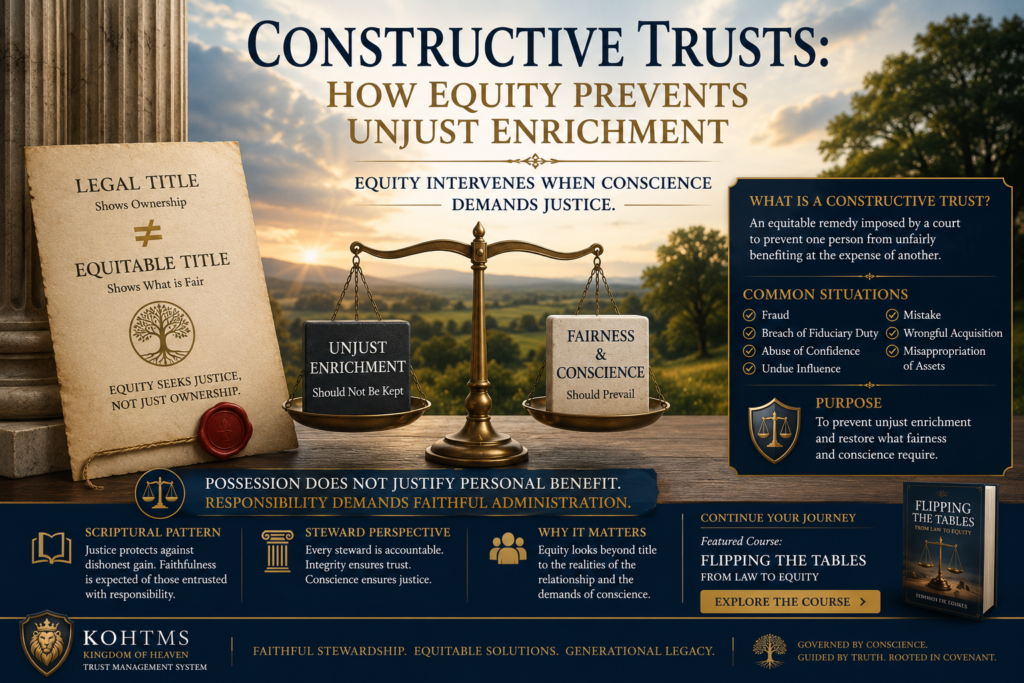
It is a remedy imposed by a court of equity to prevent one person from unfairly benefiting at the expense of another.
The doctrine exists because equity recognizes that there are situations where legal ownership alone does not produce a just result.
A constructive trust is an equitable remedy.
It is not created by the parties.
It is imposed by equity.
The purpose is straightforward.
To prevent unjust enrichment.
When one person acquires or retains property under circumstances that make it unfair for them to keep it, equity may recognize that the property should instead be held for the benefit of another.
The court does not create a new ownership interest.
Rather, it recognizes that conscience requires the legal owner to hold the property for someone else’s benefit.
The common law generally focuses on legal title.
Who owns the property?
Whose name appears on the deed?
Who possesses legal rights?
Equity asks an additional question.
Should this person, in good conscience, keep the benefit?
Sometimes legal title and equitable fairness align perfectly.
Sometimes they do not.
When they do not, equity developed the constructive trust as a remedy to prevent injustice.
At the heart of every constructive trust lies the concept of unjust enrichment.
Not every benefit received is unjust.
People earn wages.
Receive gifts.
Acquire property through lawful transactions.
These benefits are legitimate.
Unjust enrichment occurs when someone retains a benefit that fairness and conscience say should not be retained.
The focus is not simply upon enrichment.
The focus is whether keeping the benefit would be inequitable.
While every situation depends upon its own facts, constructive trusts commonly arise where property has been obtained through circumstances such as:
Fraud
Breach of fiduciary duty
Abuse of confidence
Undue influence
Mistake
Wrongful acquisition
Misappropriation of assets
In each case, the central concern is whether allowing the legal owner to retain the property would produce an unjust result.
Constructive trusts frequently appear in fiduciary relationships.
Trustees.
Executors.
Agents.
Partners.
Corporate officers.
Guardians.
These relationships require loyalty and faithful administration.
When fiduciaries improperly benefit from property entrusted to them, equity may intervene to prevent personal enrichment at the expense of those they were obligated to serve.
The doctrine reinforces the high standard expected of fiduciaries.
One reason constructive trusts belong within equity is that equity traditionally acts upon the conscience of the individual.
Rather than focusing exclusively upon technical legal ownership, equity asks whether conscience permits the individual to retain the benefit.
If conscience says no, equity may require the holder to account for the property as though it were held in trust.
This reflects equity’s broader concern for justice rather than mere technical ownership.
A constructive trust is not intended to punish.
Its purpose is restorative.
The objective is to prevent unjust enrichment and restore fairness.
The doctrine does not necessarily accuse the legal holder of criminal conduct.
Instead, it recognizes that certain circumstances require equitable intervention so that property is administered consistently with justice.
The principle carries important lessons for stewardship.
Stewards administer resources entrusted to them.
Those resources are not administered solely for personal advantage.
Faithful stewardship requires loyalty.
Honesty.
Accountability.
Responsible administration.
The constructive trust reminds every steward that possession does not automatically justify personal benefit.
Responsibility accompanies authority.
Although constructive trusts arise through equitable principles rather than formal documents, documentation remains important.
Records.
Communications.
Financial transactions.
Administrative decisions.
These often help demonstrate the true nature of the relationship and the circumstances surrounding the property.
Good records strengthen faithful stewardship.
Poor records often create unnecessary uncertainty.
Throughout Scripture, justice consistently protects against dishonest gain.
Those entrusted with responsibility are expected to administer faithfully.
Those who abuse positions of trust are repeatedly warned against using their authority for personal advantage.
These themes closely parallel the equitable concern that no one should profit through conduct that violates conscience and faithful stewardship.
Within the Kingdom of Heaven Trust Management System, stewardship always carries accountability.
The Creator remains the ultimate Owner and Settlor.
Stewards administer resources entrusted to their care.
Constructive trust principles reinforce the idea that administration must always be governed by integrity.
Legal title alone does not determine faithful stewardship.
Faithfulness determines faithful stewardship.
Modern transactions often involve complex relationships.
Businesses.
Families.
Trusts.
Partnerships.
Estates.
Property.
Whenever people rely upon one another, trust becomes essential.
Constructive trusts remain one of equity’s important tools for protecting those relationships when legal ownership alone fails to produce a just result.
They remind us that justice considers not only what is legally possible but also what conscience requires.
Constructive trusts demonstrate one of equity’s central purposes.
Preventing unjust enrichment.
Protecting trust relationships.
Promoting faithful stewardship.
They remind us that legal ownership is not always the end of the inquiry.
Equity asks the deeper question.
Should this benefit, in fairness and conscience, remain where it is?
The faithful steward understands that every position of trust carries responsibility.
Authority must be exercised faithfully.
Benefits must be received honestly.
Resources must be administered with integrity.
Because the greatest protection for both property and relationships is faithful stewardship guided by justice, conscience, and accountability.
Flipping the Tables: From Law to Equity
Learn how constructive trusts, resulting trusts, equitable remedies, fiduciary duties, unjust enrichment, and the historic principles of equity work together to promote justice and faithful stewardship.
What Is Equity? Understanding the Principles Behind Fairness, Responsibility, and Remedies
Equity Looks to Substance Rather Than Form: Why Intent Matters
The Maxim “He Who Comes Into Equity Must Come With Clean Hands”: What It Really Means
The Fiduciary Standard: Why Trustees Are Held to a Higher Duty
Trust Administration Versus Ownership Administration: Why the Difference Matters