
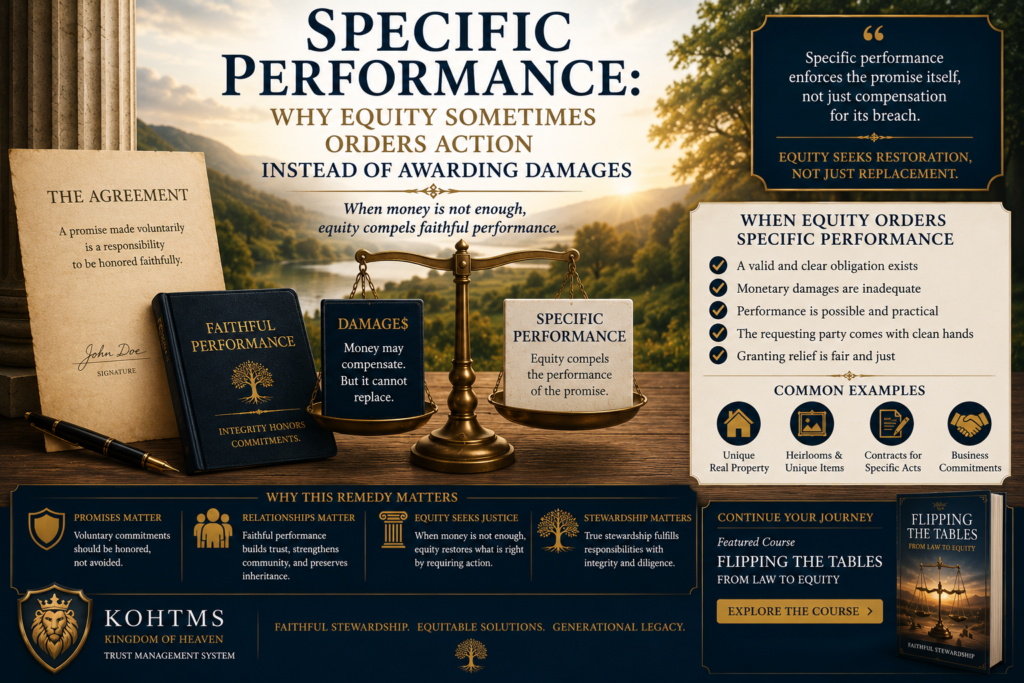
When people think about legal remedies, they often think about money.
Someone suffers a loss.
The court awards damages.
The dispute ends.
While financial compensation is an important remedy, it is not always an adequate one.
Some obligations cannot be satisfied simply by paying money.
Some promises involve unique property.
Some agreements involve relationships that cannot be replaced.
Some losses cannot truly be measured in dollars.
For these situations, equity developed one of its most powerful remedies:
Specific performance.
Rather than awarding monetary compensation, a court of equity may order a party to perform the obligation they voluntarily agreed to undertake.
This reflects one of equity’s central concerns—doing justice when money alone is insufficient.
Specific performance is an equitable remedy that compels a party to carry out a contractual or legal obligation.
Instead of asking,
“What amount of money would compensate for the loss?”
Equity asks,
“Would justice be better served by requiring the promised act to be performed?”
If the answer is yes, and the circumstances justify equitable intervention, specific performance may become the appropriate remedy.
Many agreements involve unique property or unique obligations.
A family farm.
A historic home.
A rare work of art.
A parcel of land.
An heirloom.
A one-of-a-kind business opportunity.
If these are wrongfully withheld, financial damages may not truly replace what was lost.
No amount of money creates another identical property.
No payment restores a unique family inheritance.
Equity recognizes that fairness sometimes requires the agreement itself to be honored.
Specific performance reflects an important principle of stewardship.
Promises matter.
Commitments matter.
Voluntary agreements carry responsibility.
When individuals freely undertake obligations, equity generally favors faithful performance over convenient avoidance.
This strengthens confidence in agreements and promotes integrity in relationships.
Specific performance is not granted automatically.
Courts traditionally evaluate several equitable considerations, including:
Whether a valid obligation exists.
Whether the terms are sufficiently clear.
Whether monetary damages would be inadequate.
Whether performance is practical.
Whether the requesting party has acted fairly and in good faith.
Whether other equitable principles support granting relief.
These factors reflect equity’s commitment to fairness rather than mechanical application.
Because specific performance is an equitable remedy, the doctrine of clean hands remains important.
A party seeking equitable relief is generally expected to have acted honestly and fairly in connection with the matter before the court.
Equity seeks to encourage integrity on both sides of the relationship.
Specific performance is therefore closely connected to the broader principles of conscience, fairness, and faithful conduct.
Faithful stewardship depends upon reliability.
Communities function because promises are honored.
Families depend upon commitments being fulfilled.
Trusts depend upon faithful administration.
Businesses depend upon responsible performance.
Specific performance reflects the broader stewardship principle that voluntarily accepted responsibilities should ordinarily be fulfilled rather than avoided.
Specific performance can be particularly significant in fiduciary relationships.
Trustees.
Executors.
Agents.
Partners.
Corporate officers.
These individuals often undertake continuing responsibilities that involve more than financial obligations.
Their duties include administration.
Loyalty.
Accounting.
Preservation.
Faithful execution.
Equity recognizes that simply paying damages may not adequately fulfill these responsibilities.
Sometimes faithful performance itself is required.
One of the distinguishing characteristics of equitable remedies is restoration.
Rather than replacing what was promised with money, equity often seeks to preserve the original relationship.
The objective is not punishment.
The objective is faithful completion of legitimate obligations.
Whenever possible, equity seeks to place the parties in the position they originally contemplated when the agreement was made.
Not every agreement is suitable for specific performance.
Certain obligations involve personal services.
Others require ongoing supervision.
Some become impossible to perform.
Equity recognizes practical limitations.
The remedy is reserved for situations where faithful performance remains both possible and consistent with justice.
This careful approach preserves the integrity of equitable jurisdiction.
Throughout Scripture, keeping one’s word is consistently presented as a matter of integrity.
Commitments are expected to be honored.
Stewards are expected to remain faithful.
Trustworthiness is repeatedly valued.
The emphasis falls upon faithful performance rather than convenient withdrawal from responsibility.
Specific performance reflects this broader commitment to honoring legitimate obligations.
Within the Kingdom of Heaven Trust Management System, stewardship begins with faithfulness.
A steward accepts responsibilities voluntarily.
Those responsibilities should be administered with diligence, honesty, and integrity.
Specific performance reflects the principle that commitments should ordinarily be fulfilled rather than abandoned when circumstances become inconvenient.
Faithful stewardship strengthens trust.
Trust strengthens community.
Community strengthens future generations.
Modern life often encourages flexibility.
Promises become negotiable.
Commitments become temporary.
Obligations become optional.
Equity offers a different perspective.
Voluntary commitments matter.
Responsibilities matter.
Integrity matters.
Specific performance reminds us that justice is often best served when people faithfully perform what they freely agreed to do.
Specific performance demonstrates one of equity’s most important insights.
Justice is not always achieved through financial compensation.
Sometimes justice requires faithful performance.
The remedy reflects equity’s concern for integrity, responsibility, and restoration.
The faithful steward understands that agreements are more than transactions.
They are commitments.
Commitments build trust.
Trust builds relationships.
Relationships build communities.
Communities preserve inheritance.
For this reason, equity sometimes looks beyond money and instead requires the fulfillment of promises.
Because faithful performance often restores what money never could.
Flipping the Tables: From Law to Equity
Discover how equitable remedies such as specific performance, injunctions, accounting, constructive trusts, and fiduciary obligations work together within the historic system of equity and how these principles continue to influence faithful stewardship and trust administration today.
What Is Equity? Understanding the Principles Behind Fairness, Responsibility, and Remedies
Equity Will Not Suffer a Wrong Without a Remedy: Understanding Equitable Relief
The Maxim “He Who Comes Into Equity Must Come With Clean Hands”: What It Really Means
The Fiduciary Standard: Why Trustees Are Held to a Higher Duty