
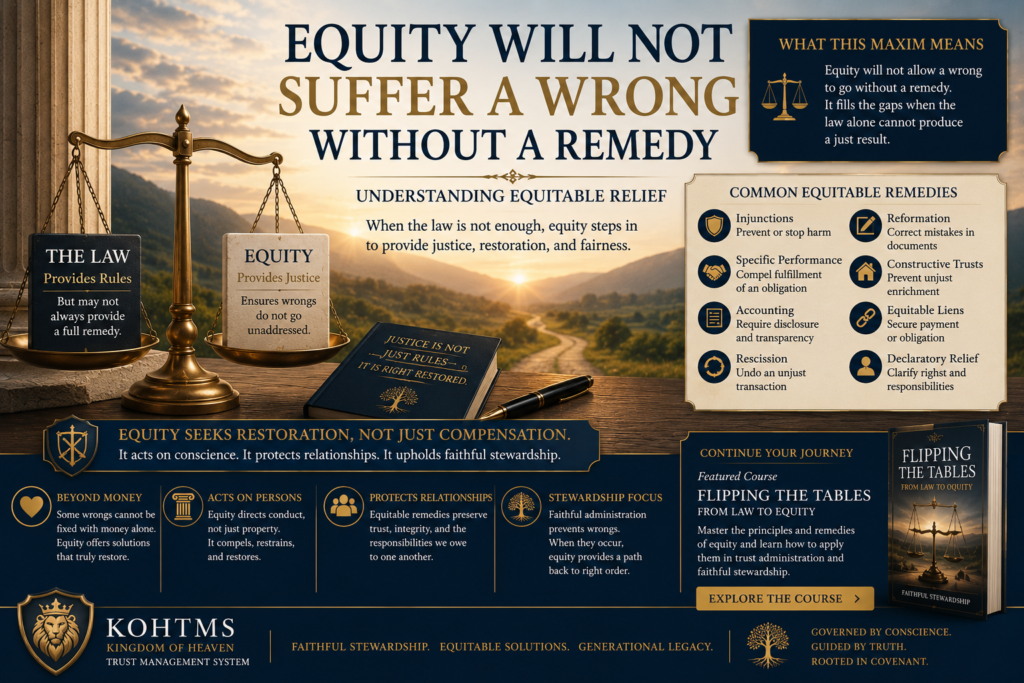
One of the oldest maxims of equity declares:
“Equity will not suffer a wrong without a remedy.”
This simple statement captures one of the primary reasons courts of equity developed in the first place.
Throughout history, situations arose where the strict application of legal rules produced results that appeared incomplete or unjust.
A legal right might exist.
A wrong might clearly have occurred.
Yet the available legal remedy failed to fully address the harm.
Equity developed to fill those gaps.
Its purpose was not to replace the law.
Its purpose was to ensure that justice could still be achieved when the law alone proved insufficient.
This principle continues to influence equitable thinking today.
A remedy is the means by which a wrong is addressed.
The common law traditionally focused heavily upon monetary damages.
If someone suffered harm, financial compensation was often the primary remedy available.
Equity recognized that money does not always solve every problem.
Some losses cannot be adequately measured in dollars.
Some obligations require performance rather than payment.
Some relationships require restoration rather than compensation.
Equitable remedies were developed to address these situations.
Imagine a family heirloom that has been wrongfully withheld.
Its financial value may be relatively modest.
Its sentimental and historical significance may be impossible to replace.
A monetary award may not truly solve the problem.
Or consider a unique parcel of land.
No identical property exists.
No amount of money may fully compensate for its loss.
Equity recognized that fairness sometimes requires remedies beyond financial compensation.
This realization became one of the defining characteristics of equitable jurisdiction.
Over time, equity developed a variety of remedies designed to address different circumstances.
Among the best known are:
Injunctions
Specific performance
Accounting
Rescission
Reformation
Constructive trusts
Equitable liens
Declaratory relief in appropriate circumstances
Each remedy serves a different purpose.
The objective remains consistent.
To provide justice where ordinary legal remedies prove inadequate.
One distinguishing feature of equitable relief is its emphasis upon restoration.
Rather than asking only,
“What financial loss occurred?”
Equity often asks,
“What result would most fairly restore the proper relationship?”
Sometimes that requires returning property.
Sometimes correcting documents.
Sometimes compelling performance.
Sometimes preventing future harm.
The remedy depends upon the circumstances.
The guiding principle remains fairness.
Historically, equity often acted upon the individual rather than merely upon property.
Instead of simply awarding money, equity could require a person to fulfill an obligation, cease certain conduct, provide an accounting, or administer property faithfully.
This reflects equity’s concern with conscience and responsibility.
Justice is often achieved by directing conduct rather than merely compensating for its consequences.
Equitable remedies are grounded in conscience.
The court asks not only whether a legal right exists but also whether fairness requires intervention.
Has someone abused a position of trust?
Has a fiduciary failed to administer faithfully?
Has one party been unjustly enriched?
Has legal ownership produced an inequitable result?
These questions illustrate equity’s concern for the ethical dimensions of human relationships.
The maxim does not mean that every grievance automatically results in an equitable remedy.
Equity operates within established principles.
The person seeking relief must demonstrate an appropriate basis for equitable intervention.
Other equitable doctrines may also apply.
Clean hands.
Good faith.
Laches.
Estoppel.
Adequate remedies at law.
Equity seeks fairness through disciplined principles rather than unlimited discretion.
The principles of equitable relief align naturally with faithful stewardship.
Stewards accept responsibilities.
Trustees administer property.
Fiduciaries exercise authority for the benefit of others.
When those responsibilities are neglected, equity provides mechanisms designed to restore proper administration.
This reinforces one of the central themes of stewardship:
Authority always carries accountability.
Trust relationships frequently involve ongoing responsibilities.
Administration.
Accounting.
Communication.
Loyalty.
Preservation.
Financial damages alone may not adequately address failures in these areas.
An accounting may be necessary.
A trustee may require direction.
Property may require protection.
Equity developed remedies capable of addressing these continuing responsibilities.
This makes equitable relief particularly important within fiduciary relationships.
Throughout Scripture, justice consistently involves restoration.
Broken relationships are reconciled.
Wrongdoing is corrected.
Responsibilities are reaffirmed.
Faithfulness is restored.
The emphasis repeatedly extends beyond punishment alone.
The goal is the restoration of right order whenever possible.
This restorative perspective closely parallels many of the objectives of equitable relief.
Within the Kingdom of Heaven Trust Management System, stewardship seeks restoration before conflict.
Faithful administration prevents many disputes from arising.
When problems do occur, the objective remains restoring proper stewardship whenever possible.
Equitable principles encourage solutions that preserve relationships, protect trust property, and promote faithful administration rather than merely assigning financial consequences.
Modern legal disputes often focus primarily upon monetary outcomes.
Equity reminds us that justice sometimes requires something more.
Faithful performance.
Honest accounting.
Protection of entrusted property.
Correction of administrative failures.
Restoration of trust.
These principles remain highly relevant wherever fiduciary relationships exist.
The maxim “Equity will not suffer a wrong without a remedy” reflects equity’s enduring commitment to justice.
It recognizes that fairness sometimes requires remedies beyond financial compensation.
Equity developed not to compete with the law but to complement it.
When legal remedies prove inadequate, equitable remedies seek to restore what conscience and justice require.
The faithful steward understands that true justice is not always measured by money alone.
Sometimes justice requires restoration.
Sometimes protection.
Sometimes faithful performance.
Sometimes accountability.
Because stewardship is not merely about administering property.
It is about faithfully restoring and preserving the relationships and responsibilities that property represents.
Flipping the Tables: From Law to Equity
This lesson introduces one of the foundational maxims of equity. The complete course explores equitable jurisdiction, remedies, fiduciary duties, constructive trusts, injunctions, accountings, and the historic principles that continue to shape equitable stewardship today.