Category
Trust Estate Foundations
Reading Time
Approximately 12–15 minutes
Supports Learning Path
Trust Estate Foundations
Featured Course
Establishing Your Trust Estate
Free Seminar
Establishing Your Trust Estate (Available)
Key Topics
Many people use the terms trust and estate as though they describe the same thing.
Although closely related, they are not identical.
Understanding the distinction is one of the most important foundations of effective stewardship.
Confusing the two often leads to unnecessary complexity, incomplete planning, and administrative problems that could have been avoided through proper design.
A well-administered trust requires a properly structured estate.
Likewise, a properly structured estate often benefits from one or more well-designed trusts.
The faithful steward understands that these concepts work together while serving different purposes.
An estate is the total collection of interests, rights, responsibilities, and property that a person or entity administers.
It may include:
An estate is not simply a list of assets.
It is the complete body of property and responsibilities requiring administration.
Where property exists, administration eventually follows.
A trust is a fiduciary relationship.
Within that relationship, one party accepts the responsibility of administering property or interests for the benefit of another according to defined purposes and duties.
The trust provides the administrative framework.
It defines relationships.
Authority.
Responsibilities.
Standards of conduct.
Continuity.
The trust is not the estate.
The trust is one method through which portions of an estate may be administered.
Estate structuring answers questions such as:
What property exists?
Who currently administers it?
How is it organized?
What interests need protection?
What liabilities require management?
How should future administration be arranged?
Estate structuring focuses upon organization.
It creates clarity regarding the overall stewardship picture.
Trust structuring asks different questions.
Who will serve as trustee?
Who are the beneficiaries?
What authority is granted?
What fiduciary standards apply?
How are decisions documented?
How will continuity be maintained?
Trust structure focuses less upon the property itself and more upon the administration of that property.
Many people imagine an estate containing only one trust.
In reality, an estate may involve several trusts serving different purposes.
Each trust possesses its own administration.
Its own trustee.
Its own responsibilities.
Its own objectives.
Together, these trusts may support the administration of the larger estate.
Understanding this relationship helps explain why trust structuring and estate structuring should be considered together while remaining distinct.
Neither estate structuring nor trust structuring should begin with documents.
Both begin with purpose.
What responsibilities exist?
What relationships require stewardship?
What continuity should be preserved?
Only after these questions are answered can effective structures be designed.
Purpose gives direction to both the estate and the trust.
The estate identifies what has been entrusted.
The trust identifies how it will be faithfully administered.
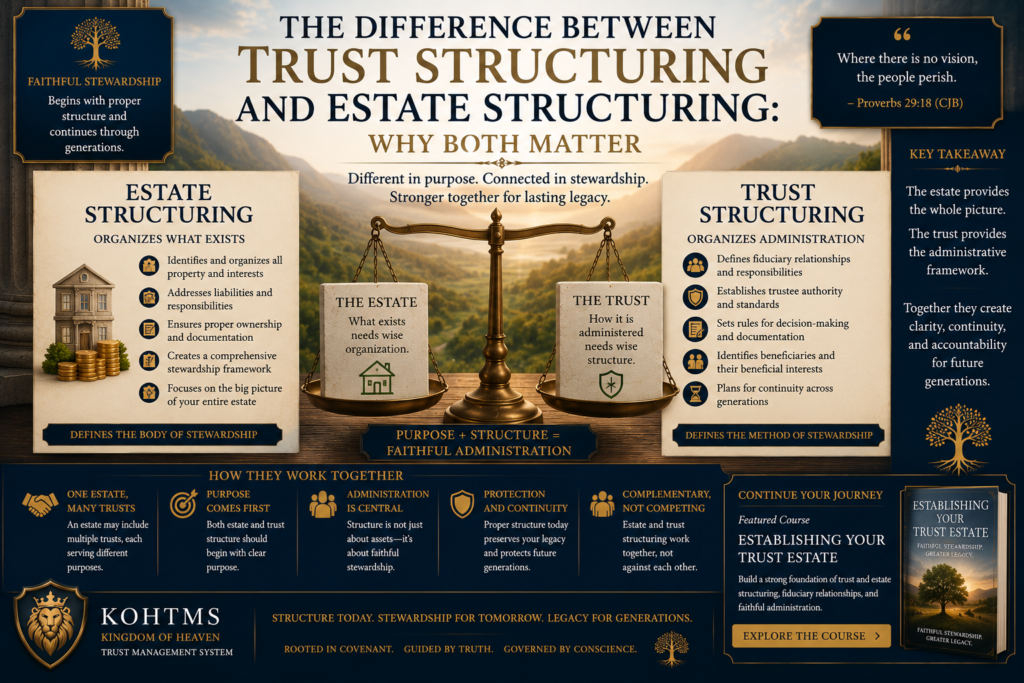
The estate defines the body of stewardship.
The trust defines the method of stewardship.
Viewed this way, both become parts of a larger system of responsible administration.
Whether discussing estates or trusts, administration remains central.
Property without administration eventually creates confusion.
Responsibilities without administration eventually create conflict.
Strong administration preserves clarity.
Continuity.
Accountability.
Future generations.
The faithful steward therefore views structuring as preparation for administration rather than merely preparation for ownership.
Several misconceptions frequently arise.
Some believe establishing a trust automatically structures an estate.
Others assume organizing an estate automatically creates proper trust administration.
Neither assumption is necessarily correct.
Both require thoughtful planning.
Both require ongoing administration.
Both require faithful stewardship.
Understanding their different purposes allows them to complement one another effectively.
Throughout Scripture, stewardship consistently involves both responsibility and administration.
Resources are entrusted.
Stewards are appointed.
Responsibilities are defined.
Accountability follows.
The pattern demonstrates careful organization combined with faithful administration.
Estate structure reflects organization.
Trust structure reflects faithful administration.
Together they support responsible stewardship.
Within the Kingdom of Heaven Trust Management System, estate structuring and trust structuring function as complementary disciplines.
The estate provides the larger framework of stewardship.
Trusts provide administrative structures within that framework.
The objective is not simply protecting assets.
The objective is creating systems capable of preserving faithful stewardship across generations.
This perspective places administration ahead of ownership and responsibility ahead of control.
Many discussions about trusts focus almost exclusively upon documents.
Many discussions about estates focus almost exclusively upon assets.
The faithful steward recognizes that neither tells the complete story.
Organization and administration must work together.
One defines what exists.
The other defines how it will be faithfully managed.
Together they create clarity.
Continuity.
Accountability.
Long-term stewardship.
Trust structuring and estate structuring are closely connected, yet they serve different purposes.
Estate structuring organizes the whole.
Trust structuring organizes administration within that whole.
One identifies the body of stewardship.
The other establishes the framework through which stewardship is carried out.
The faithful steward understands that lasting administration begins with thoughtful structure.
When both the estate and the trust are designed with purpose, responsibility, and continuity in mind, future generations inherit more than property.
They inherit an organized system of faithful stewardship capable of serving them for years to come.
If this article helped clarify the relationship between trust structuring and estate structuring, these resources will help you continue building a strong foundation in trust administration.
Explore the principles of trust formation, estate organization, fiduciary relationships, stewardship, and administrative design through a comprehensive learning path built for long-term understanding.
Establishing Your Trust Estate – Free Seminar
Learn the foundational principles behind trust and estate structuring in this introductory seminar.
Next Article
Trust Administration: Moving From Public Administration to Private Stewardship